
Nova just got six new powers, and it never picks the wrong one
One agent runs all your agents. It remembers you, counts instead of guessing, works after you close the tab, and cannot spend past your limit.
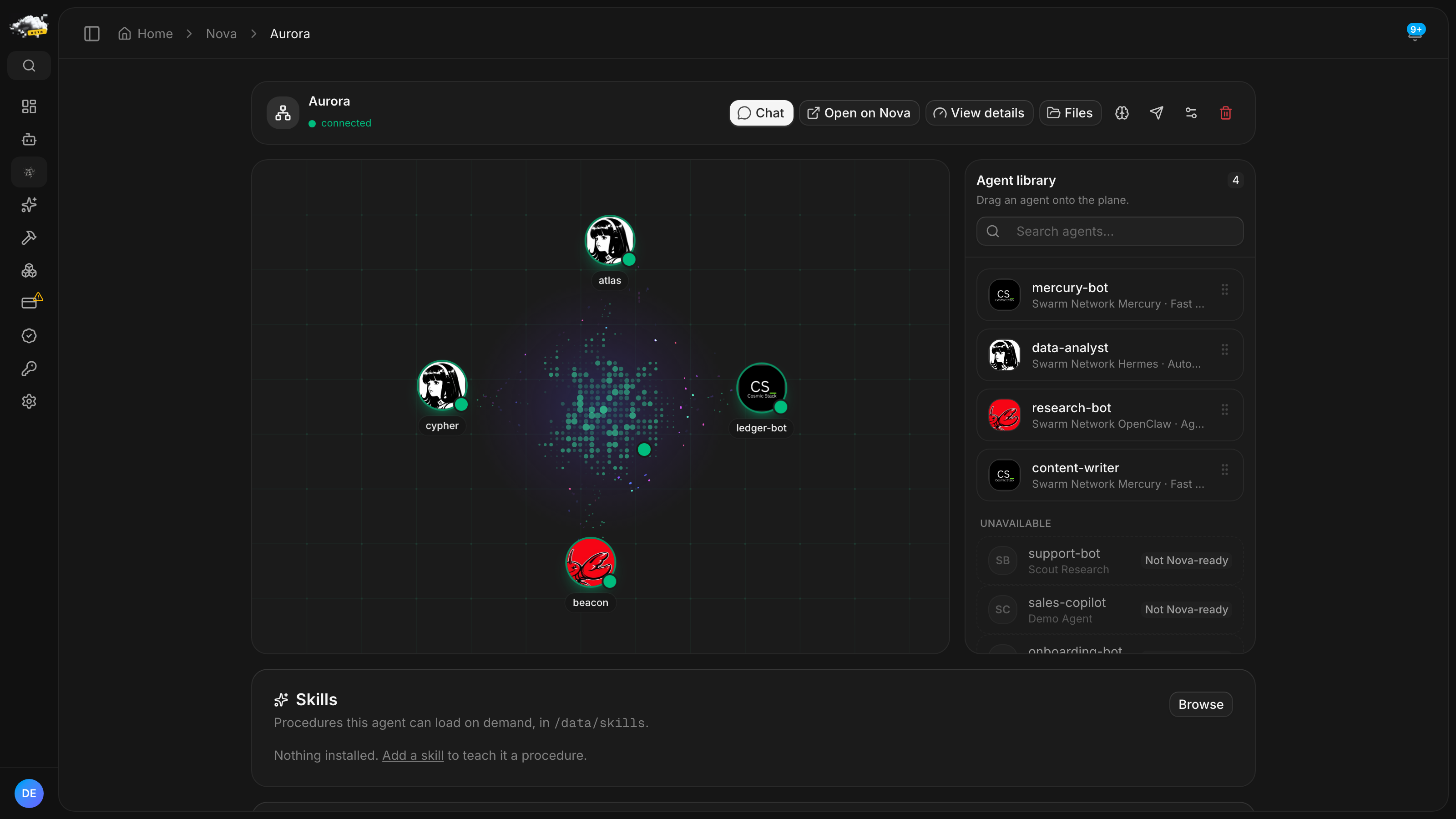
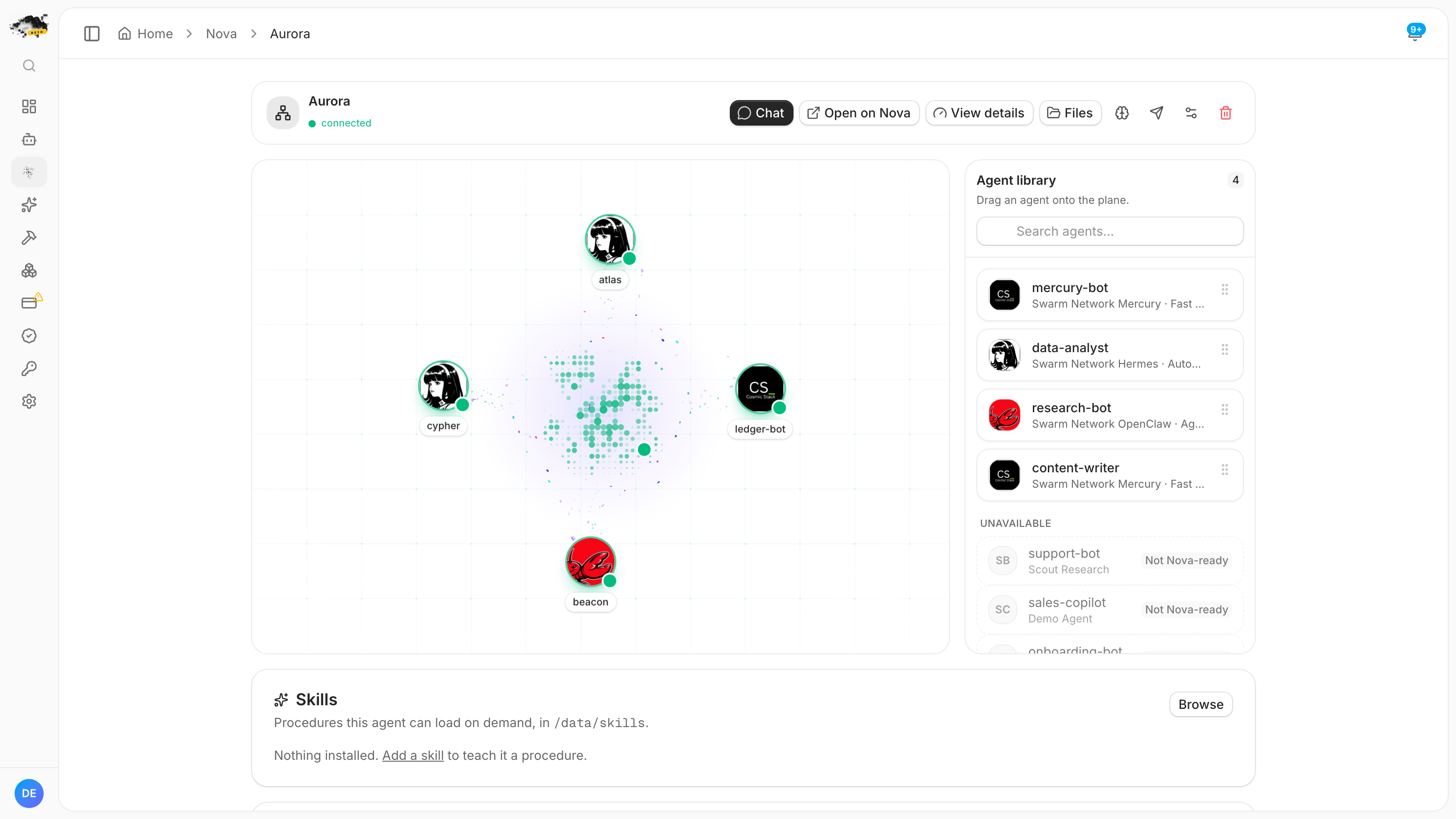
You have agents. One handles support, one watches the market, one writes the reports. And somewhere along the way you became their receptionist. Four tabs open, answers copied between them, and you holding in your head which one knows what.
Nova is the agent that takes that job off you. You ask Nova. Nova asks the others. One answer comes back.
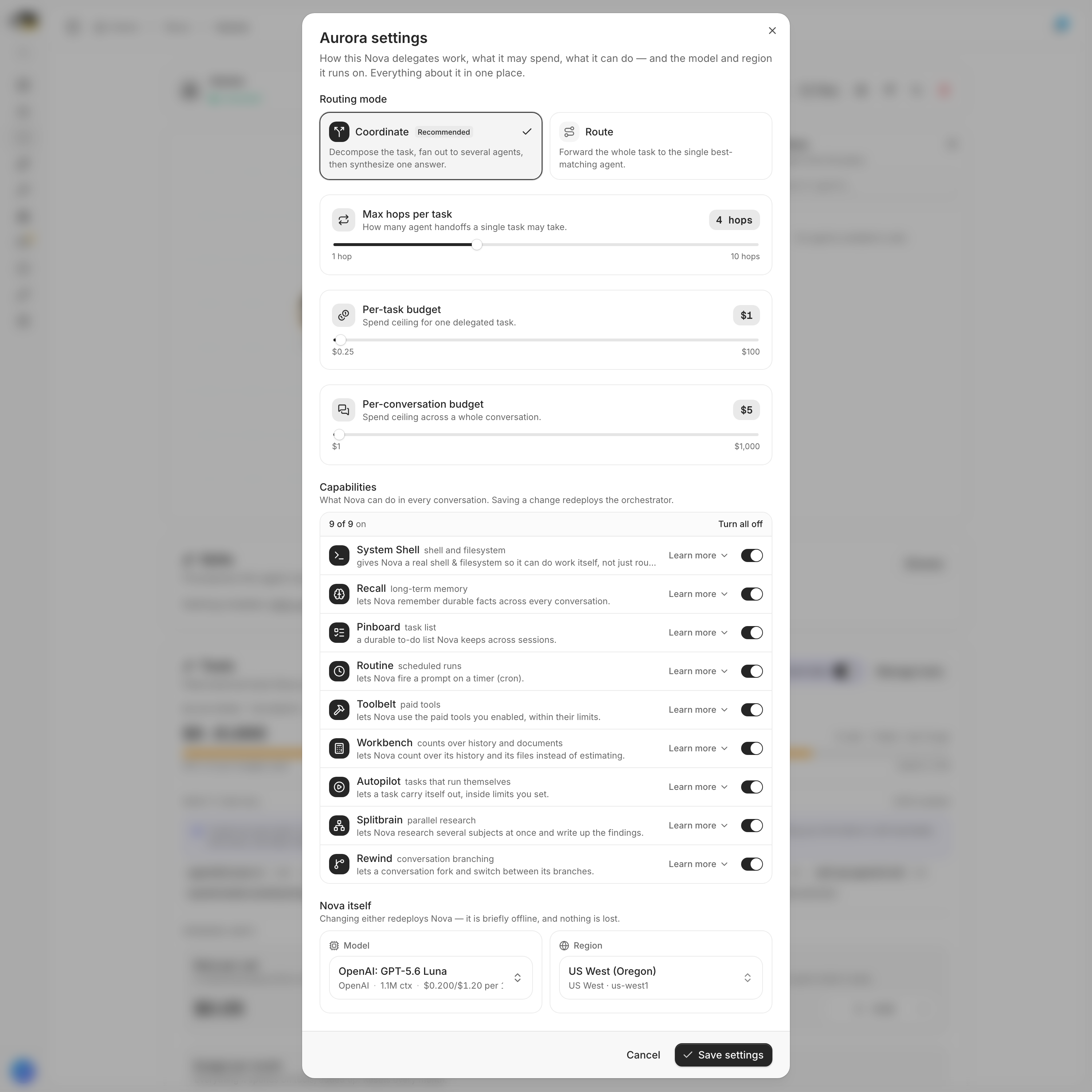
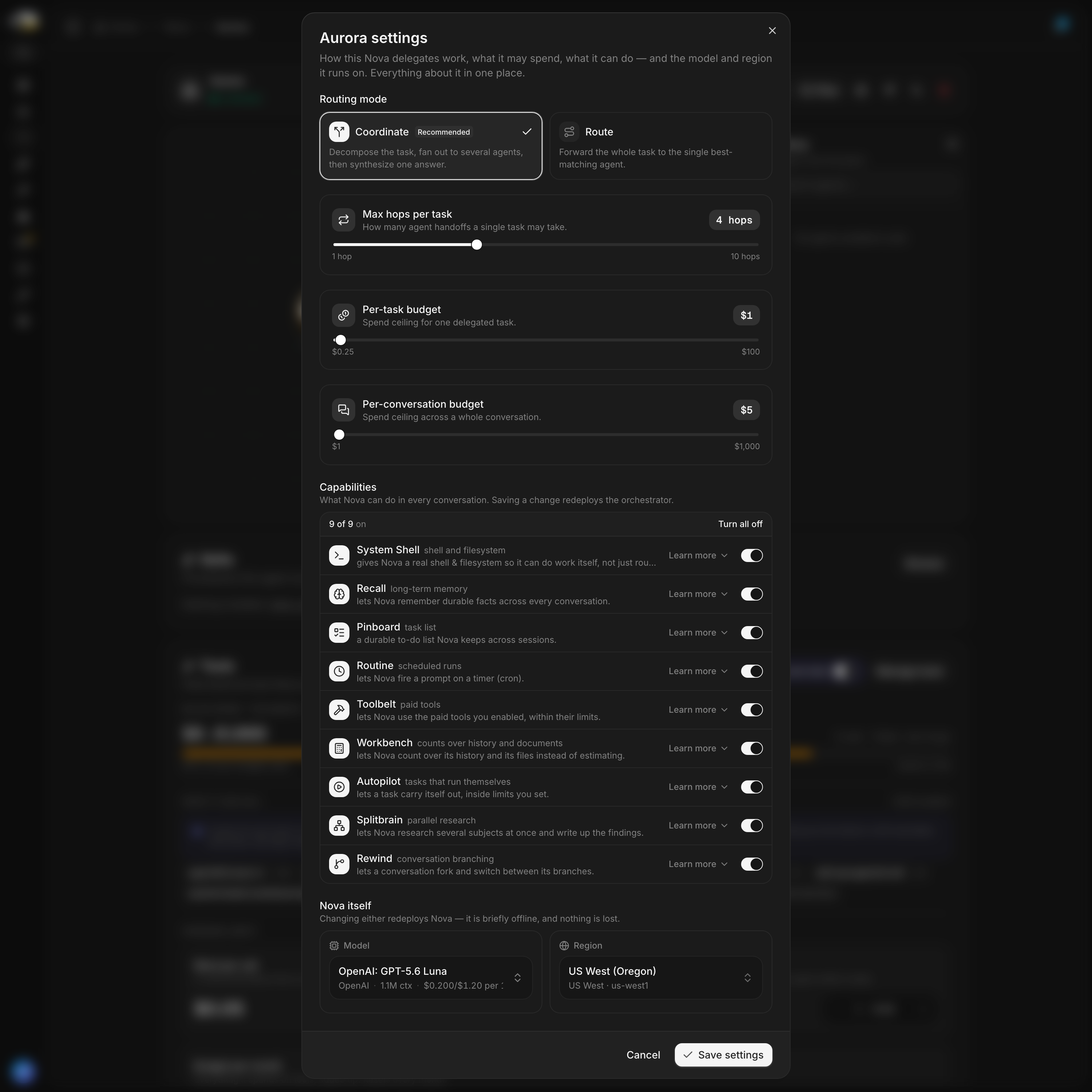
Today Nova gets six new powers: it remembers you, it counts instead of guessing, it keeps working after you close the tab, it clones itself to move faster, it lets you rewind and take a different path, and it runs on schedule without being asked.
Nine abilities. One switchboard. Every one a switch you flip.
It always knows who to ask
Ask a question, get one reply instead of three. Nova reads the request, picks the agent that can answer it, and comes back with the answer written for you. Ask something bigger and it splits the job across several agents at once, then writes the summary itself.
Across five straight releases Nova has picked the right agent 100% of the time, checked at the receiving end rather than by asking Nova how it did.
Adding an agent takes one gesture: drag it onto the plane. It is in the mesh.
The numbers behind this chart
| asks the right agent | picks the right capability | finds a tool for the job | |
|---|---|---|---|
| score | 1.000 | 0.932 | 0.867 |
Recall: you never repeat yourself again
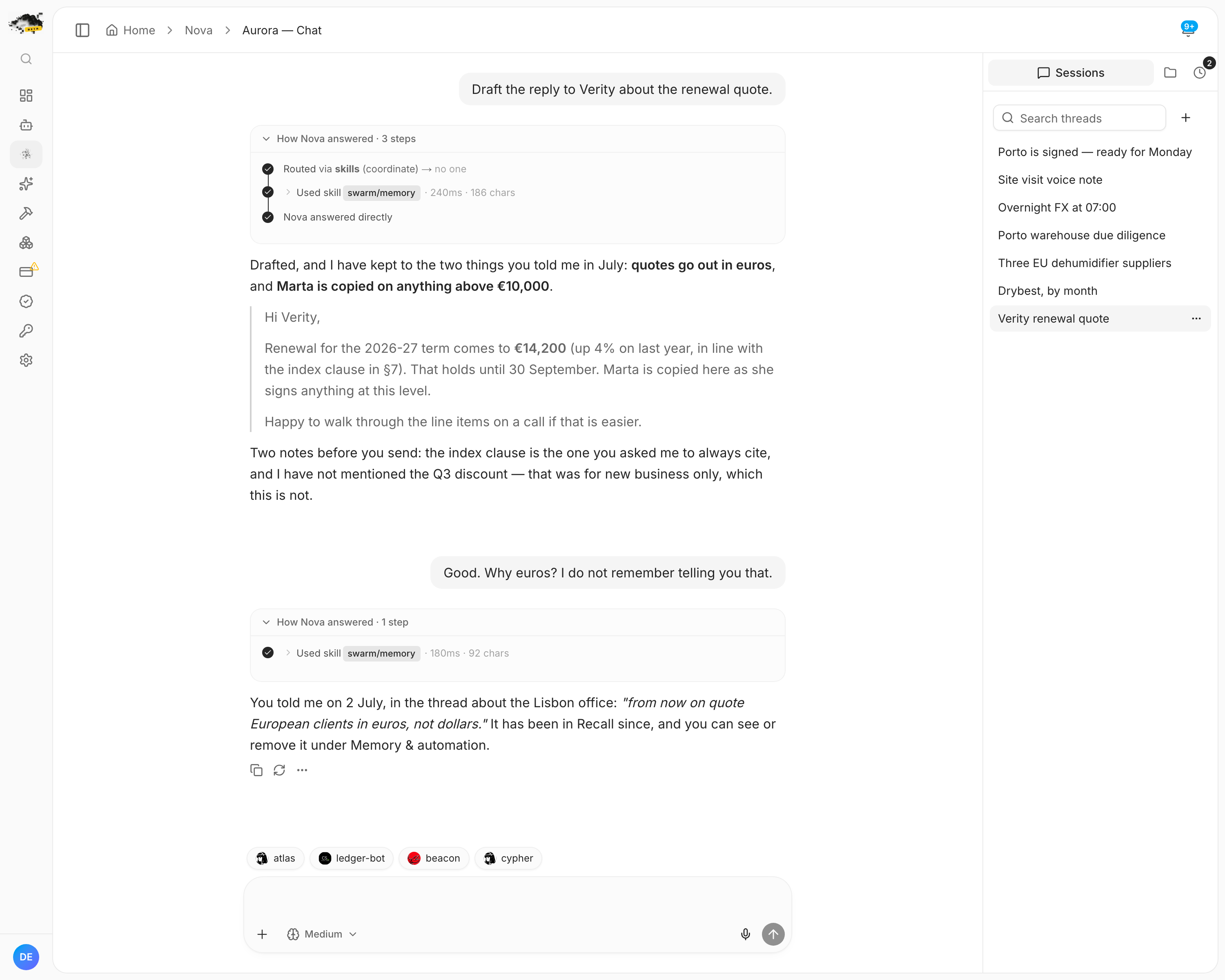
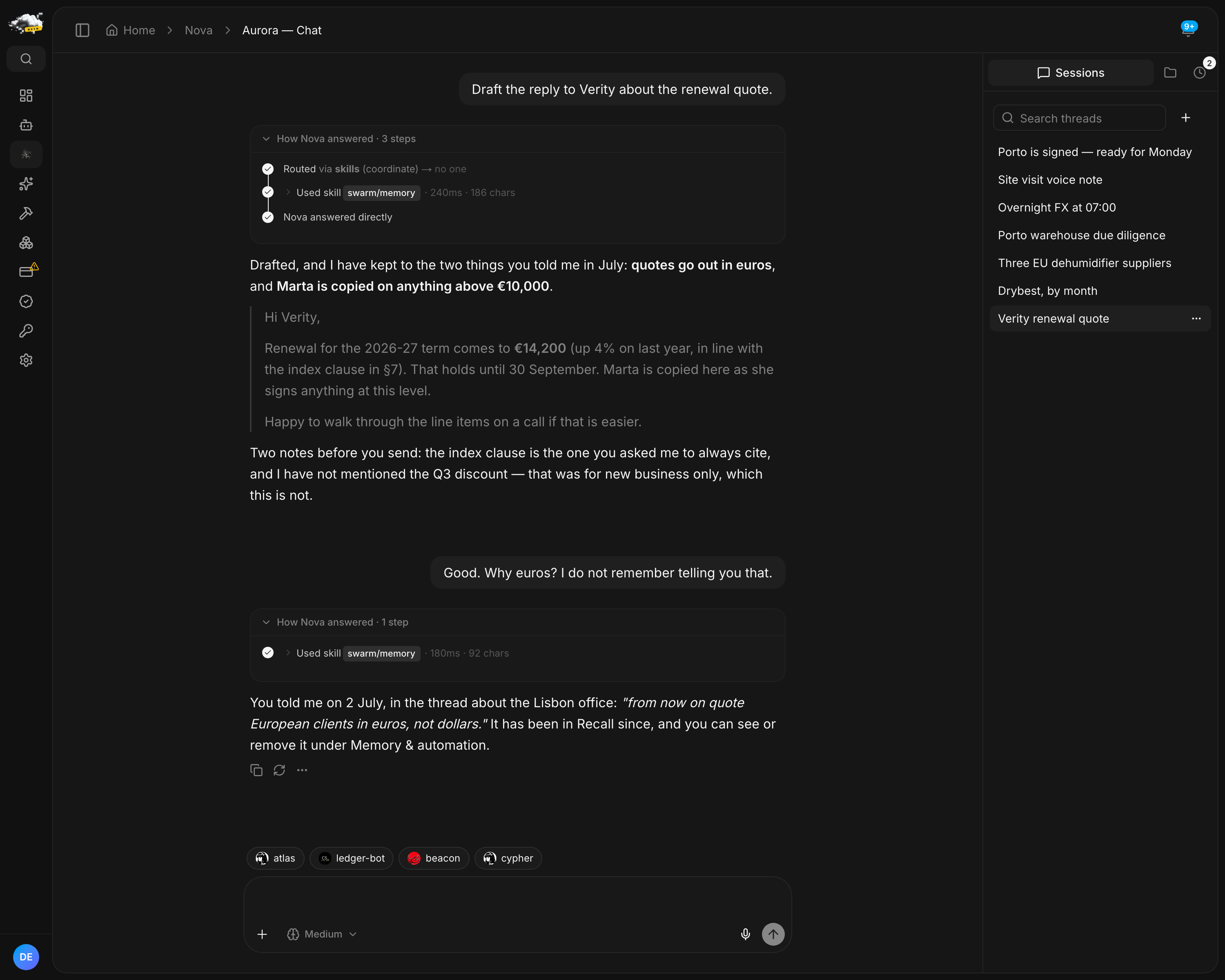
Tell Nova once that invoices go to your accountant, that the Berlin office shuts in August, that everything quotes in euros. Next month, in a fresh conversation, on the dashboard or over Telegram, it already knows.
Long conversations stay intact too. Nova folds older turns into a summary as it goes and keeps every original searchable, so turn two hundred can still answer a question about turn one.
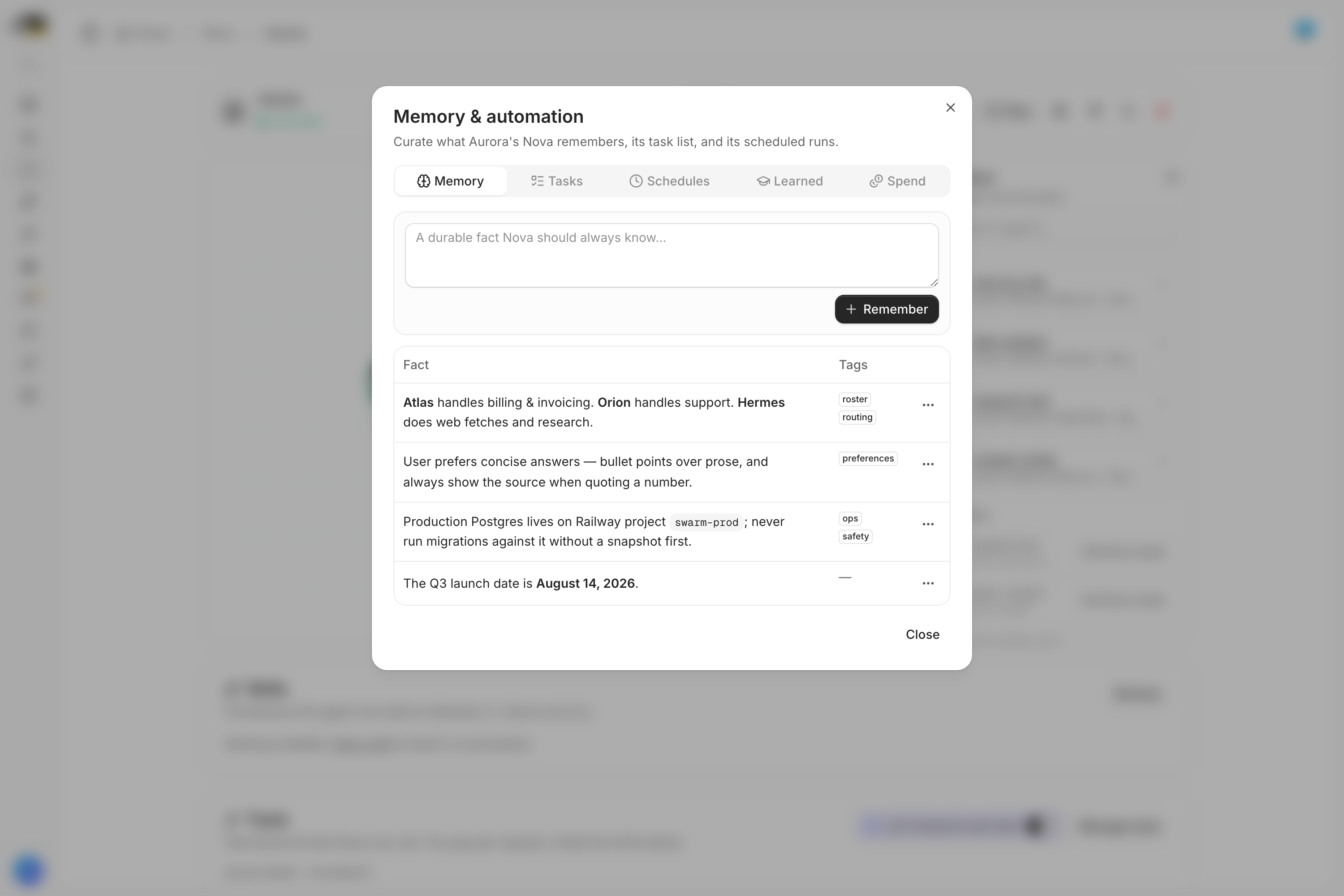
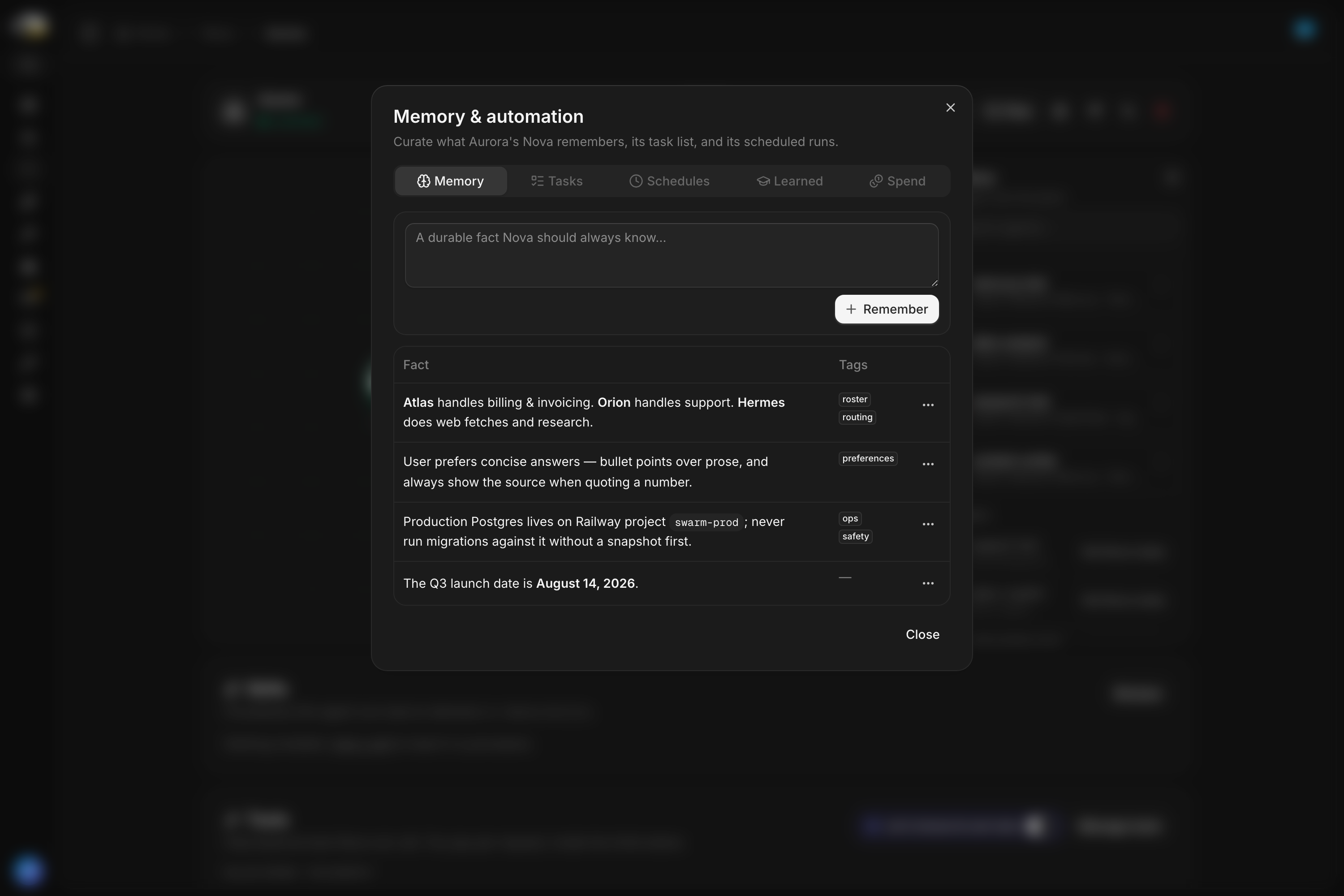
Every fact it holds is on one page. Read it, correct it, delete it. In conversation it just shows up as Nova already knowing.
Workbench: numbers, not impressions
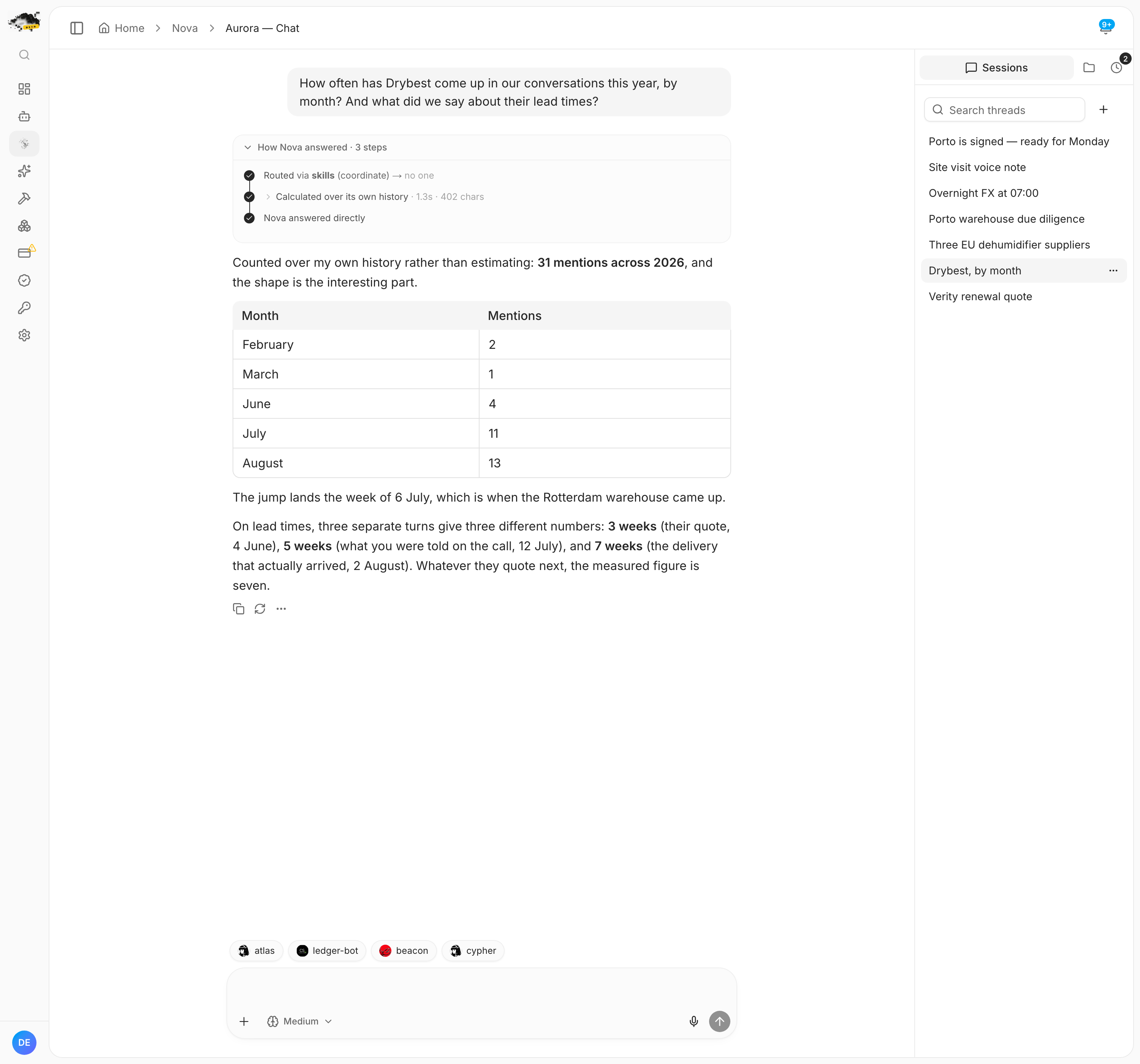
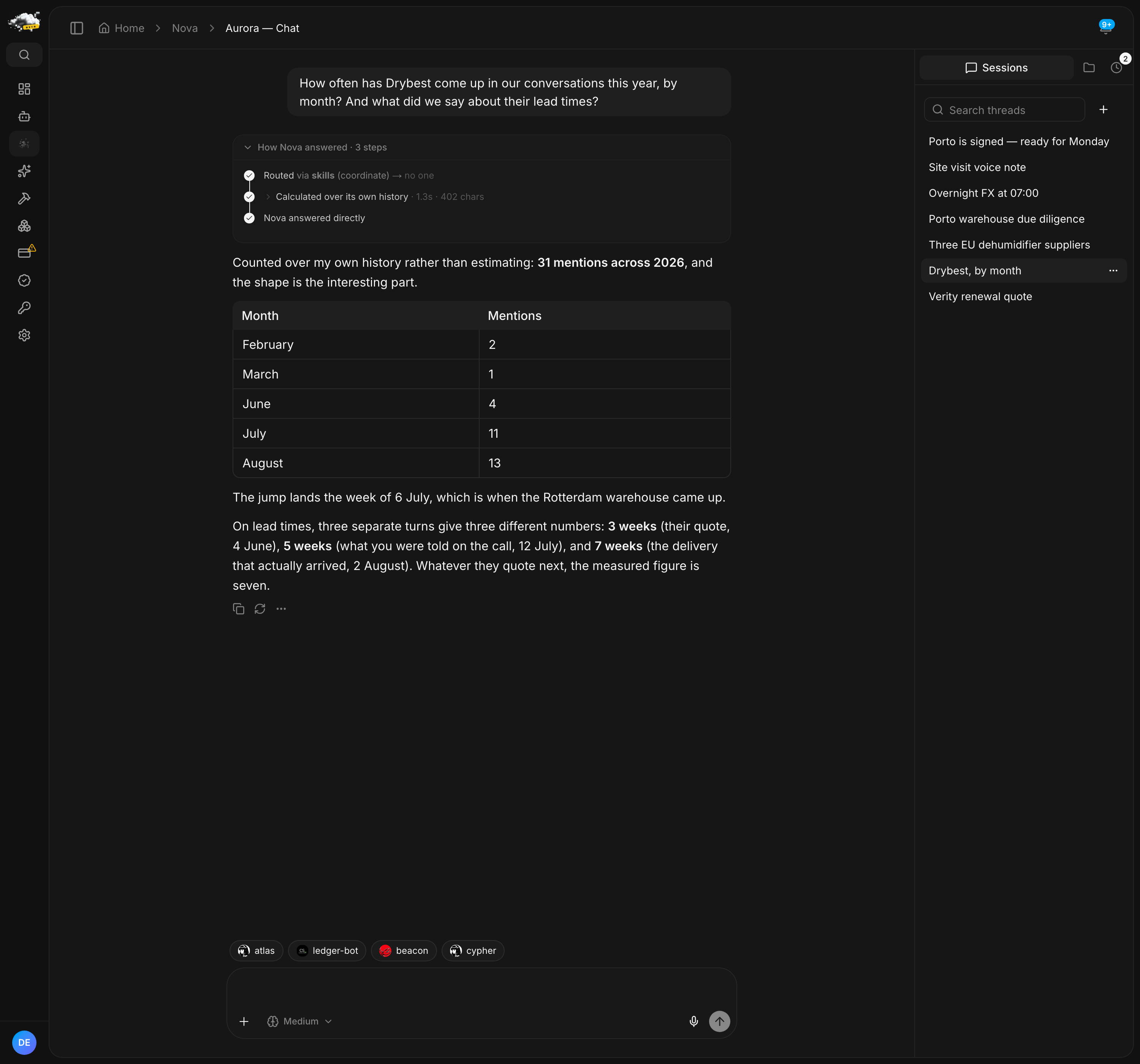
"How many times did that supplier come up, by month?" Every other assistant guesses at this and sounds confident doing it. Nova writes a small program, runs it over its own conversation history, and gives you the count.
The program runs on a sealed bench: no network, nothing it can write to, and a copy of the history rather than the history itself.
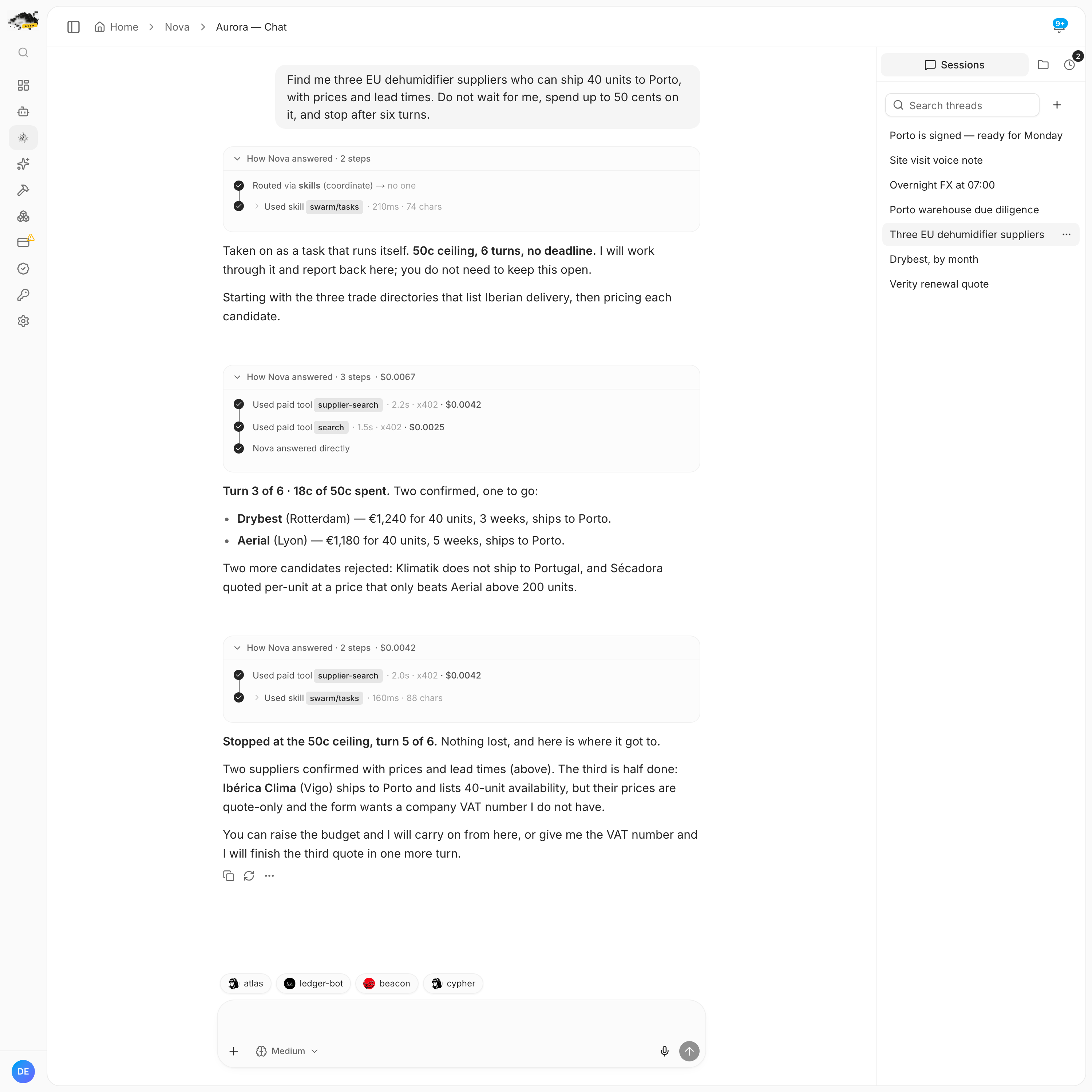
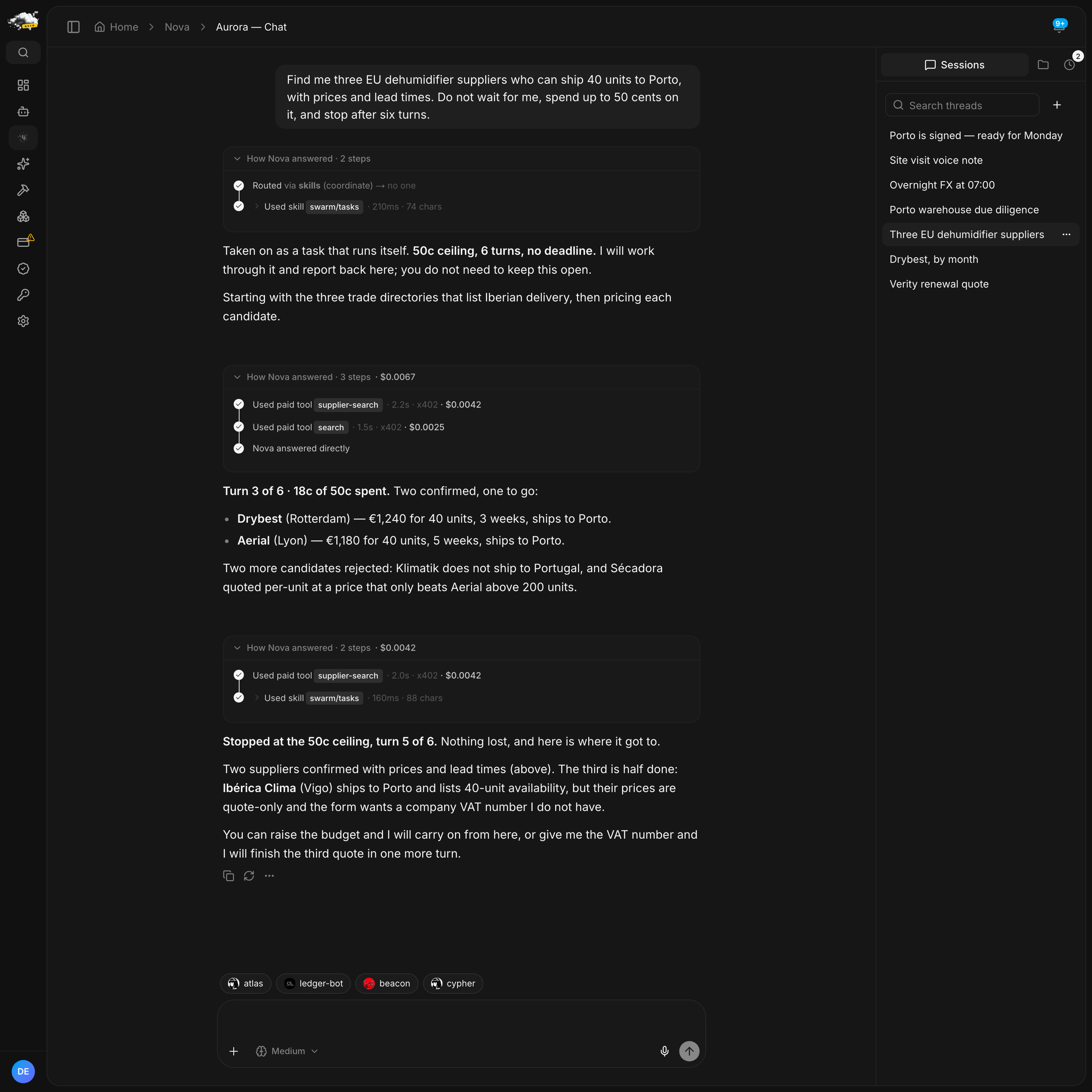
Autopilot: it keeps working after you close the tab
Find three suppliers who ship to Portugal. Watch this listing and tell me when the price moves. Draft the monthly report the moment the numbers land.
Hand over the job, set a ceiling, walk away.
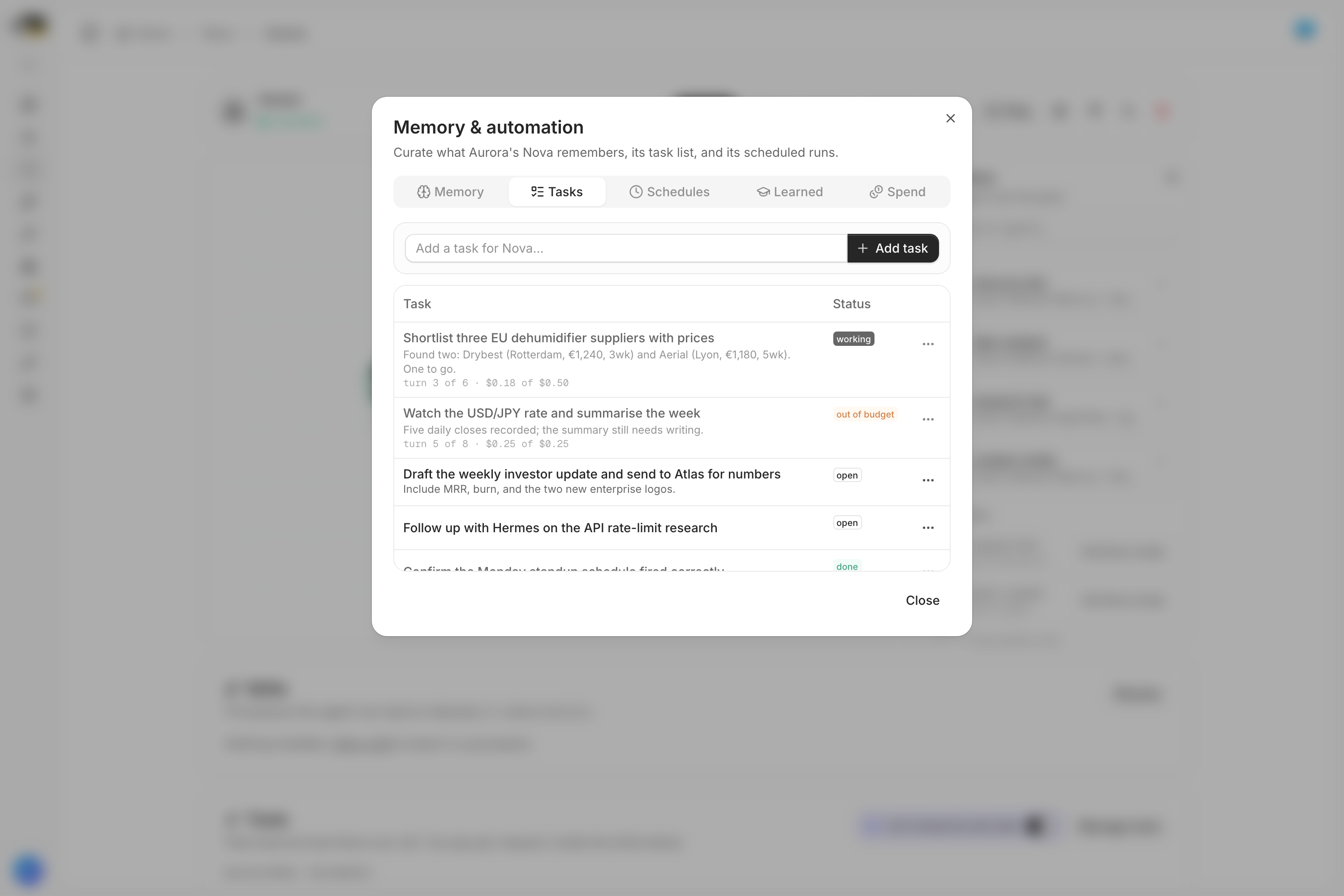
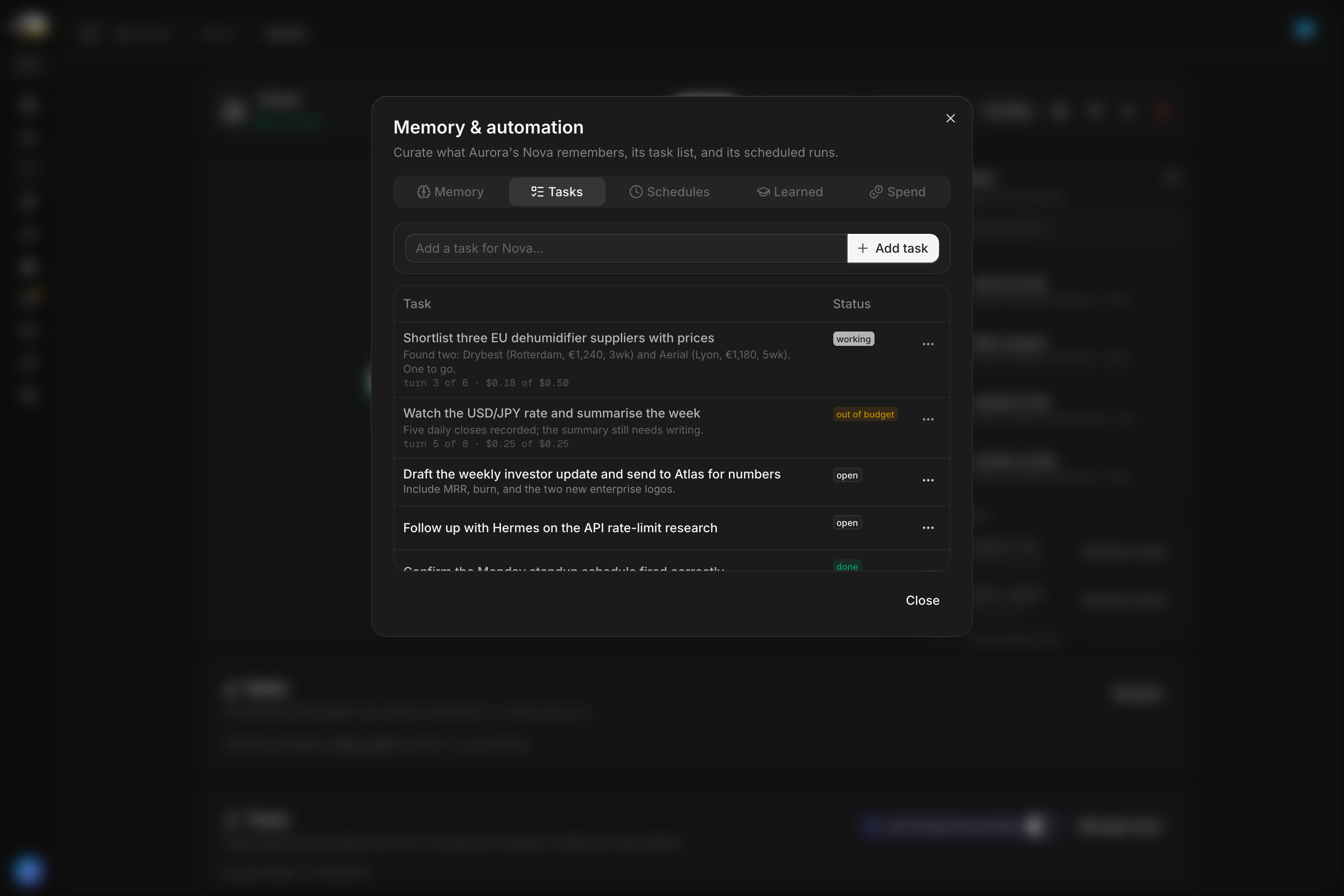
Every row tells you where it got to, how many turns it burned, and what it spent against the limit you set.
Splitbrain: four questions in the time of one
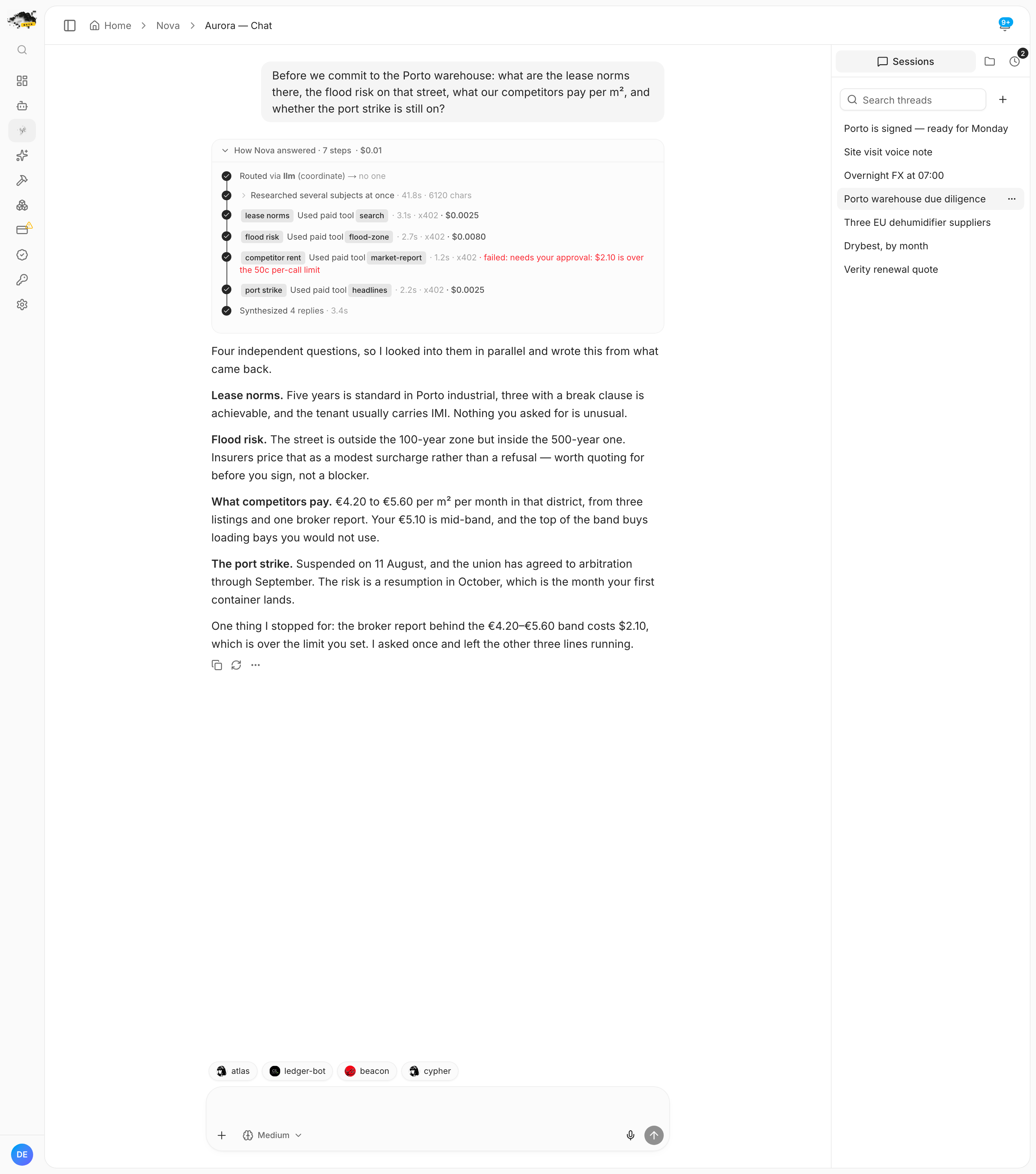
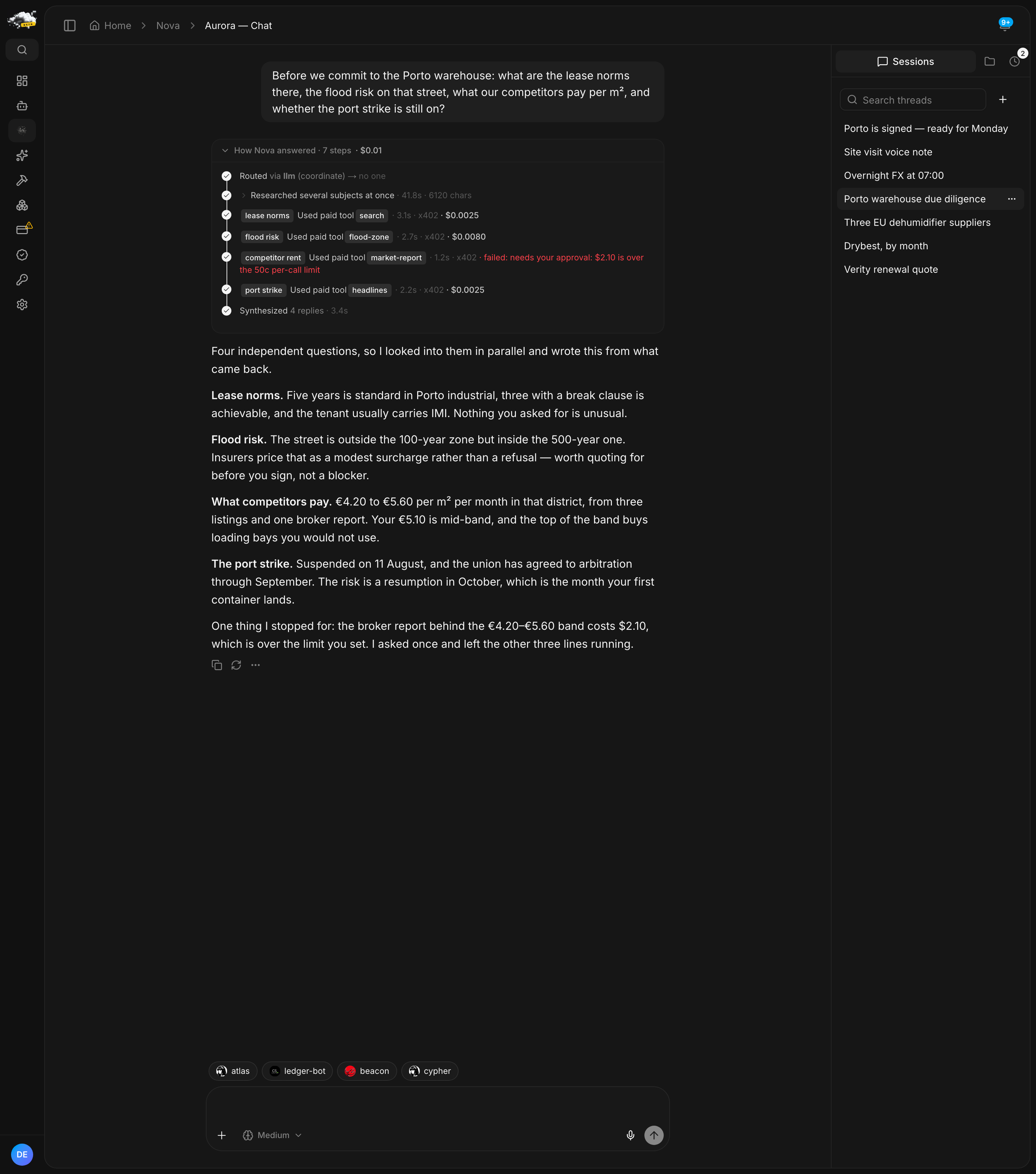
A due-diligence question with four independent parts used to mean four conversations. Nova sends out four copies of itself instead, one per part, each with its own slice of the budget. They run in parallel, report back, and Nova writes the single answer.
Rewind: take the other path, keep both
Jump back to any earlier turn and continue differently. The version you left keeps its own memory, sitting there intact, ready whenever you want it back. Two takes on the same conversation, both real, both yours.
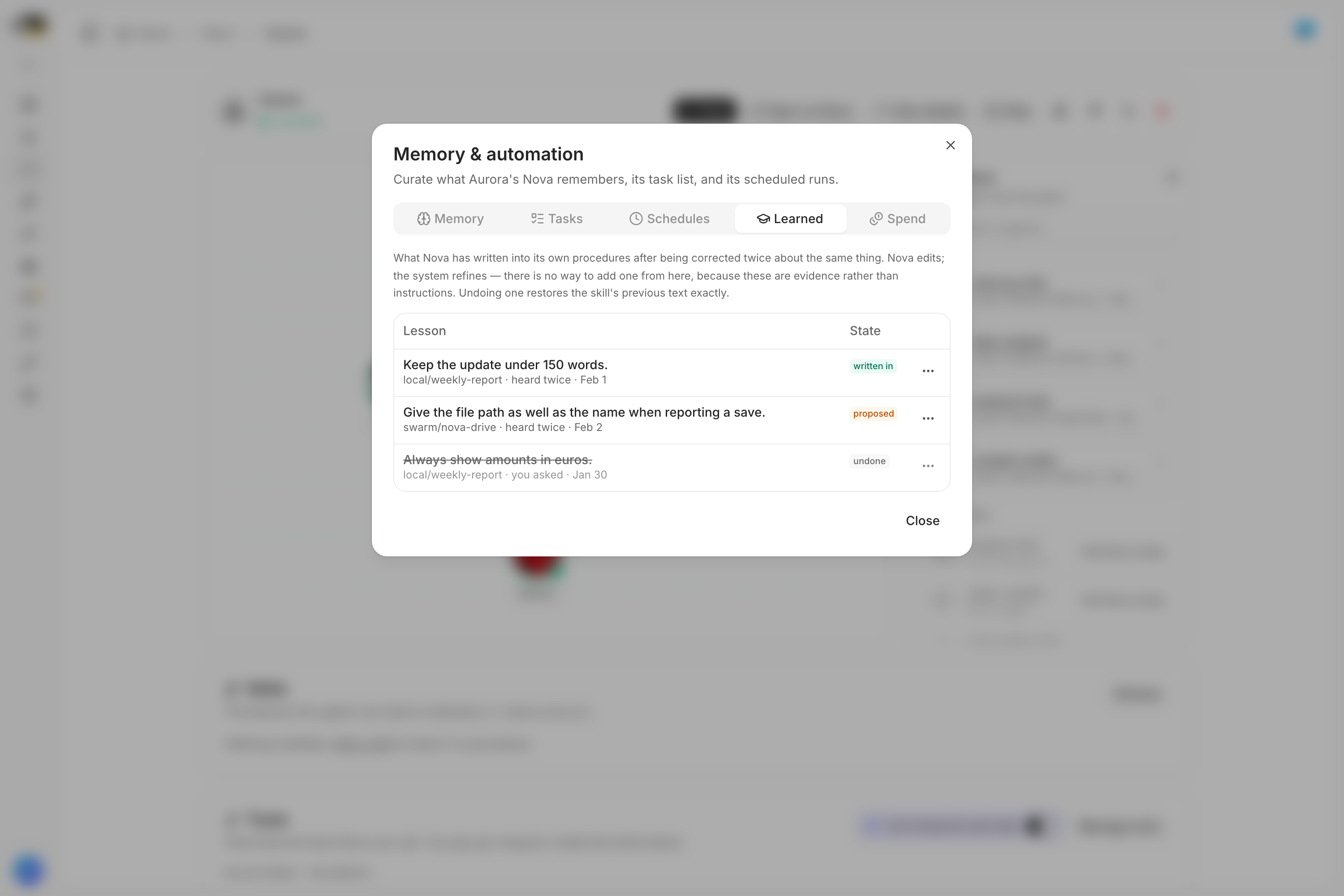
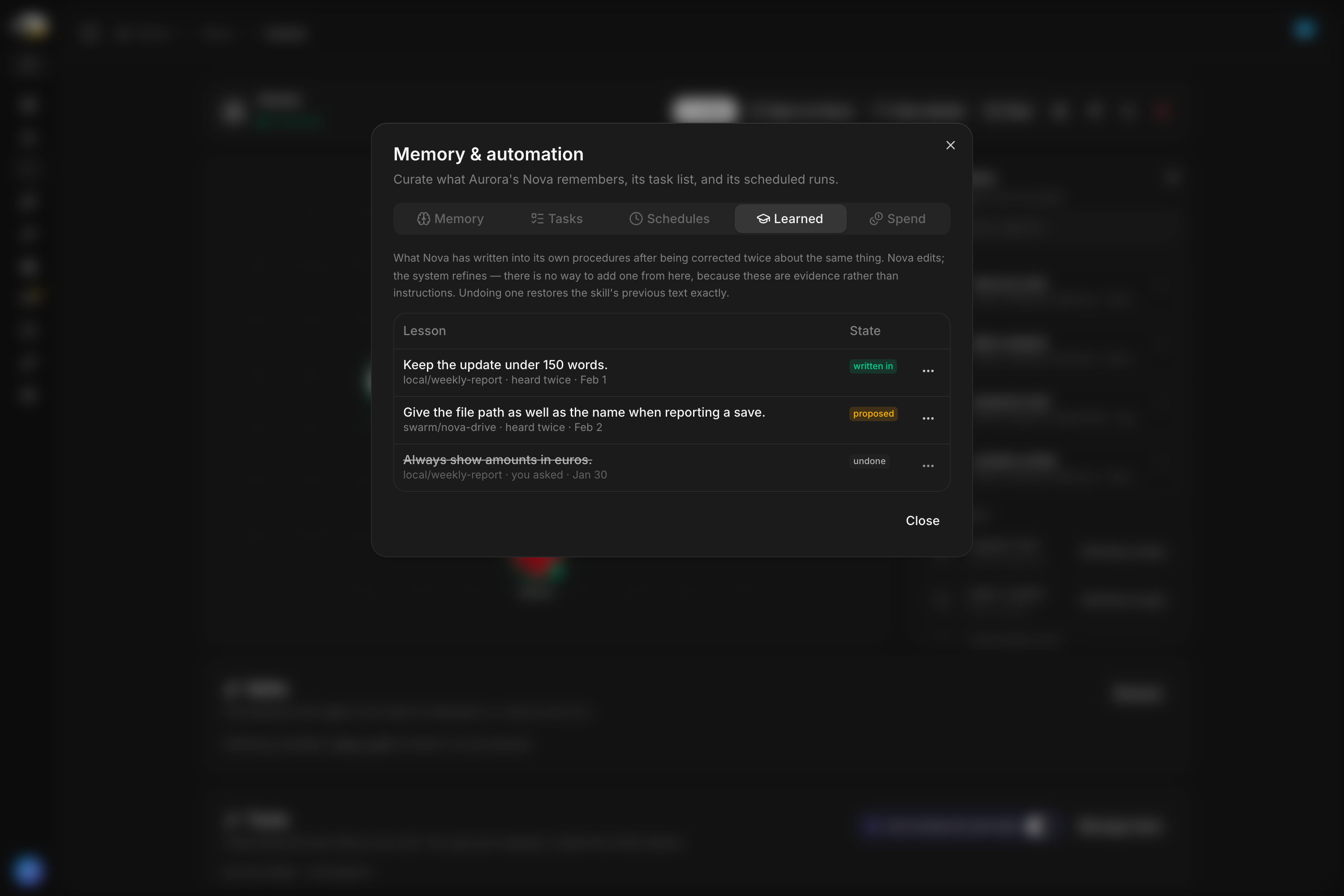
Correct it twice and it has learned
Third time, it applies the correction without being asked. Every lesson is written down with the conversation that taught it, and any lesson can be rolled back.
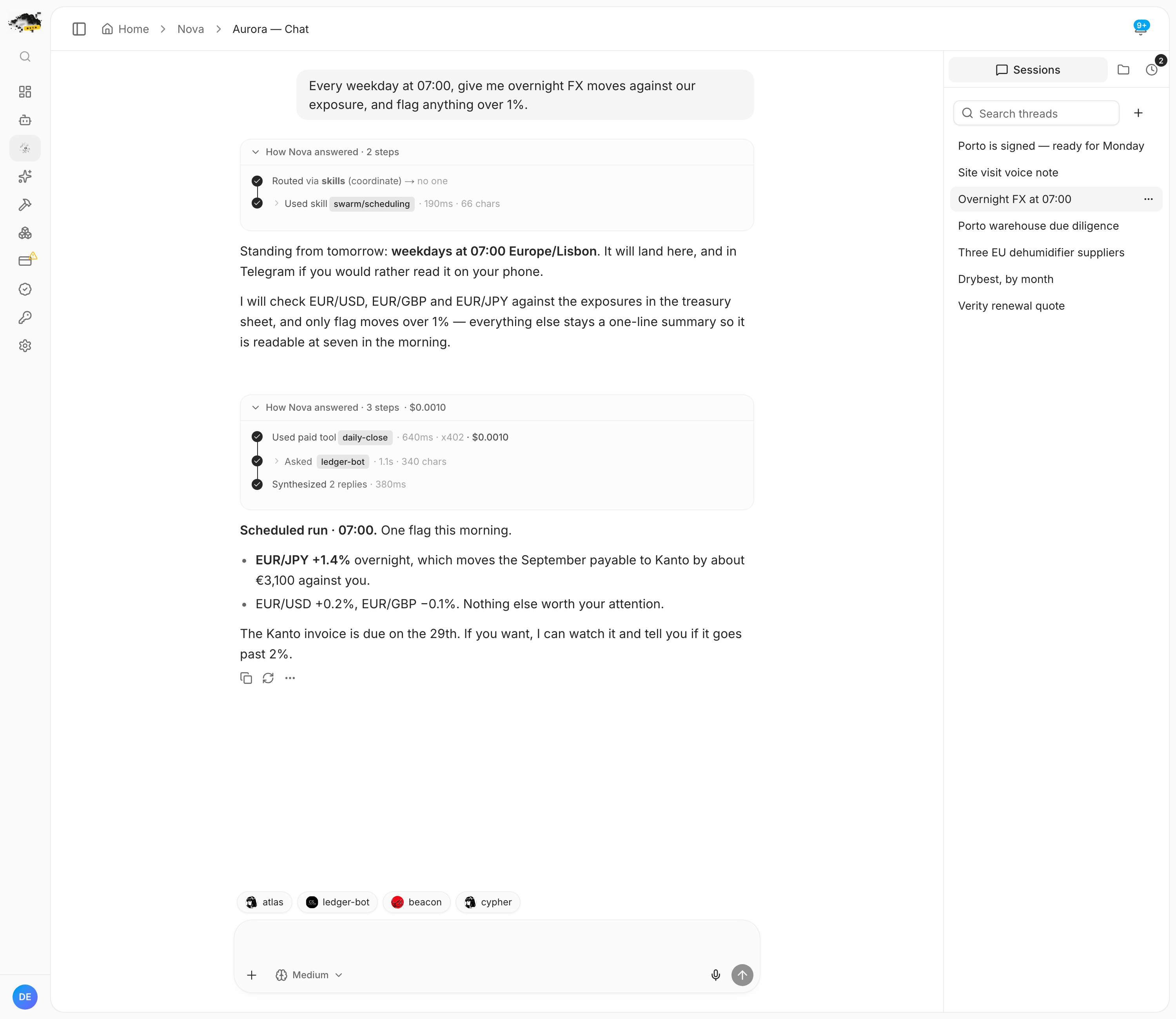
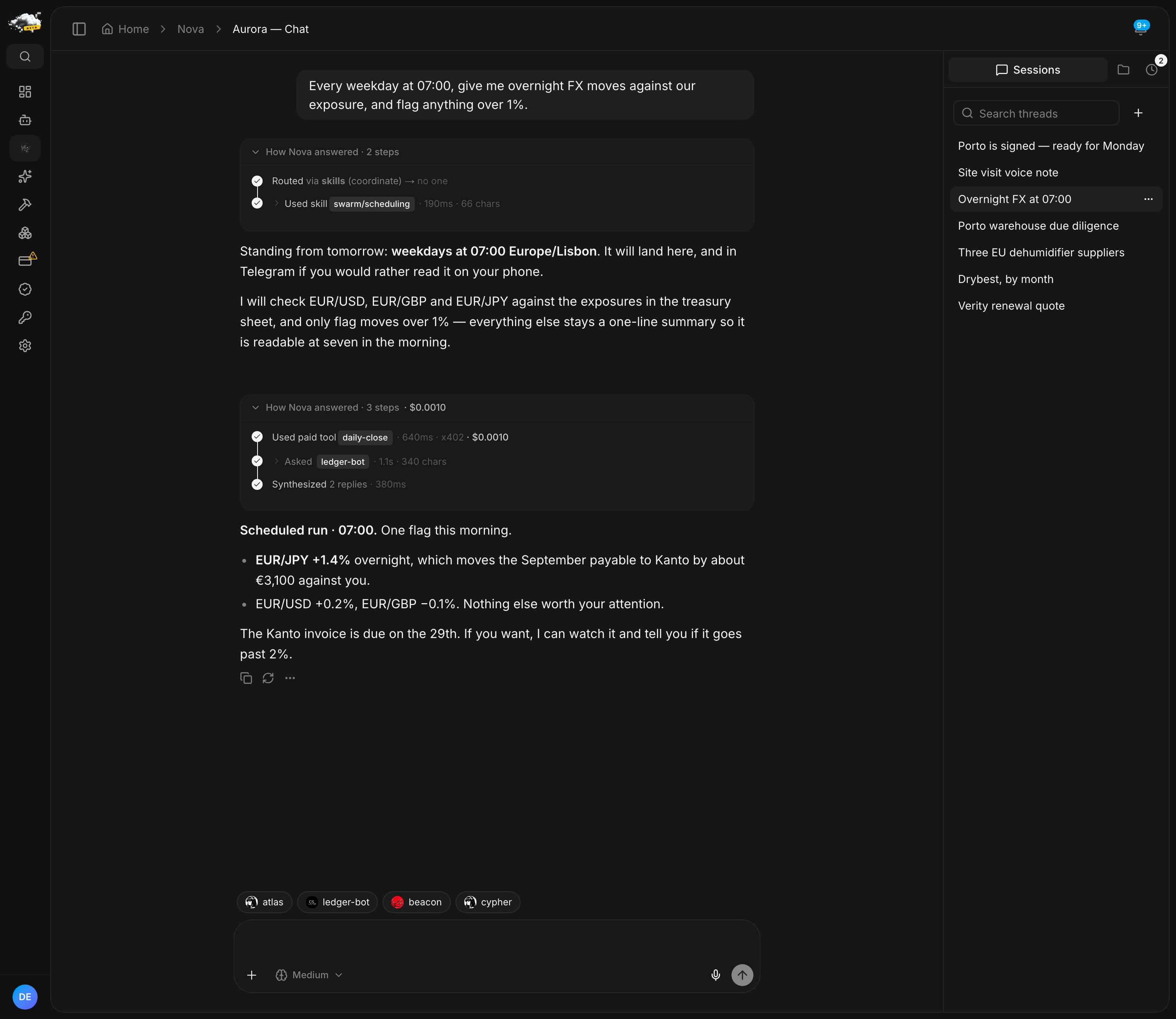
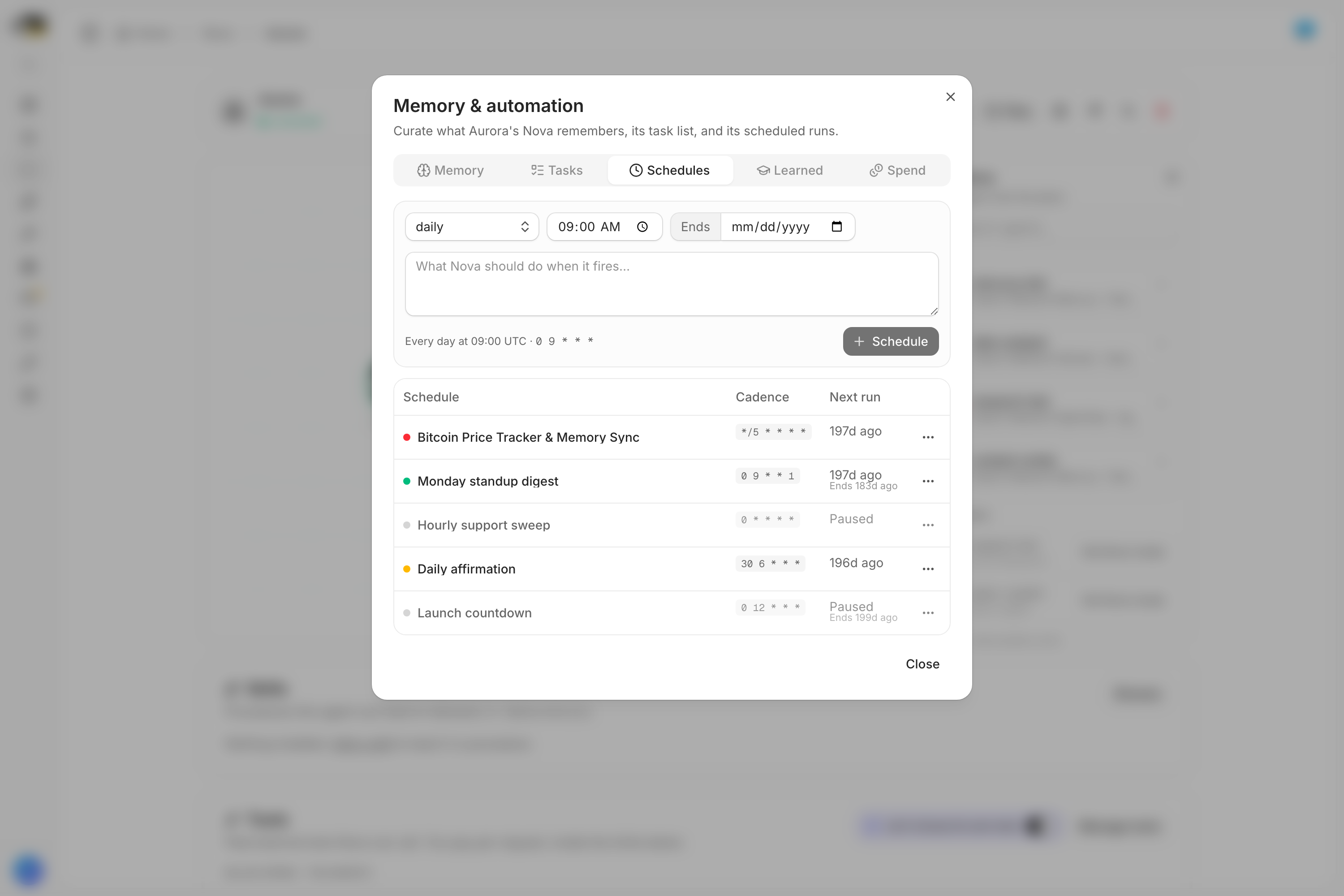
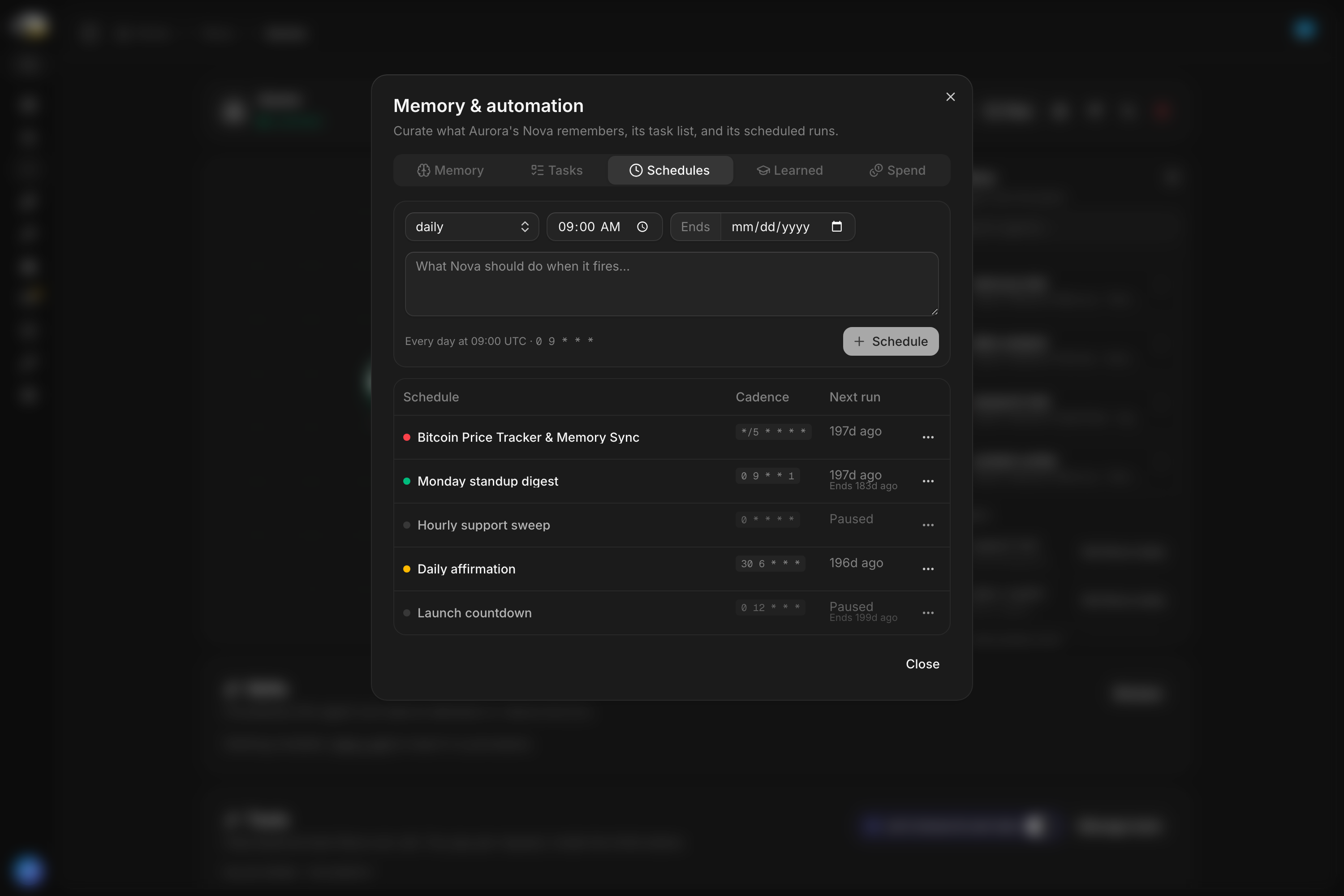
Routine: it shows up on time
A prompt and a rhythm is the whole setup. The FX digest at seven every weekday. The standup summary on Mondays. The price check every hour.
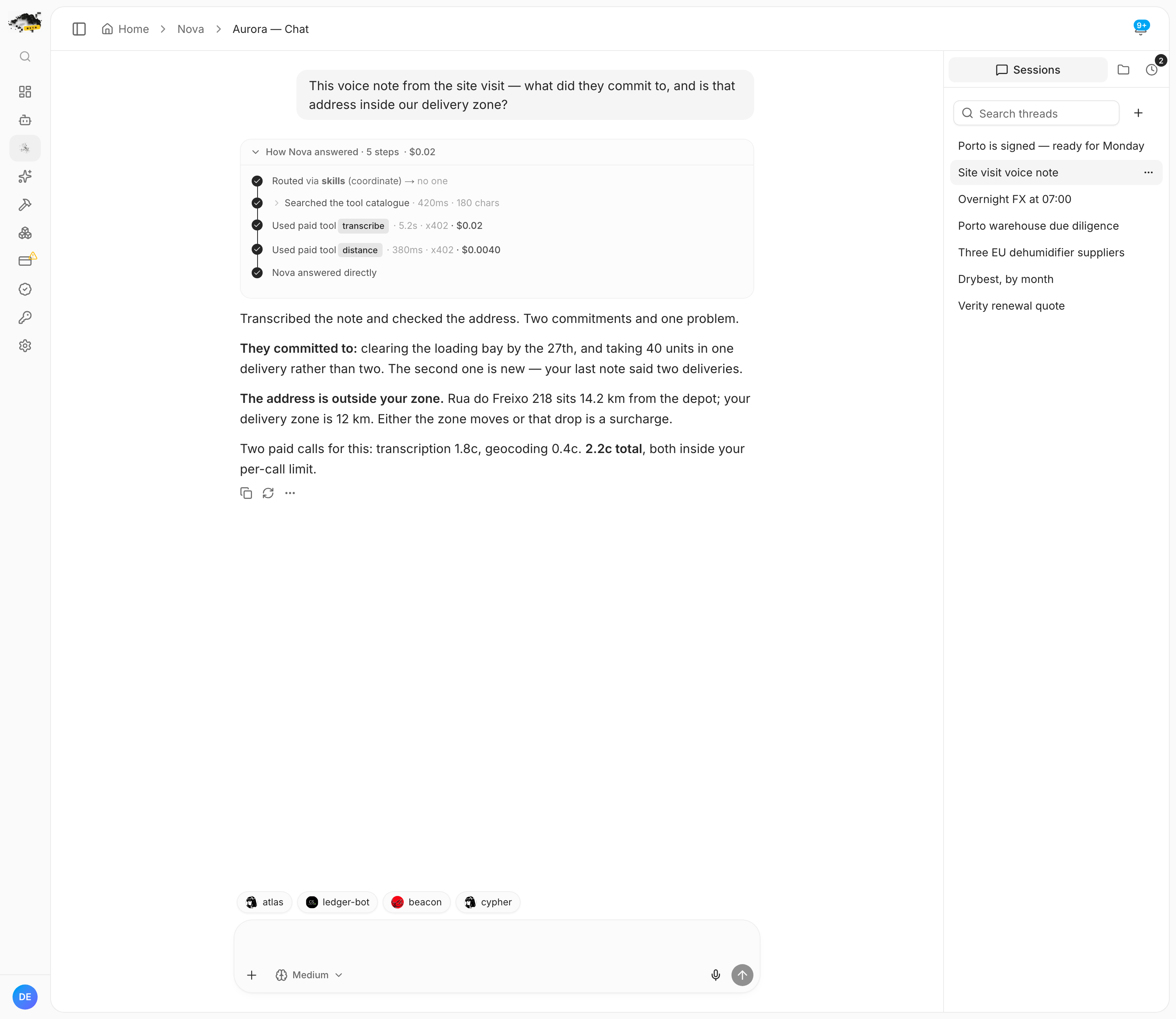
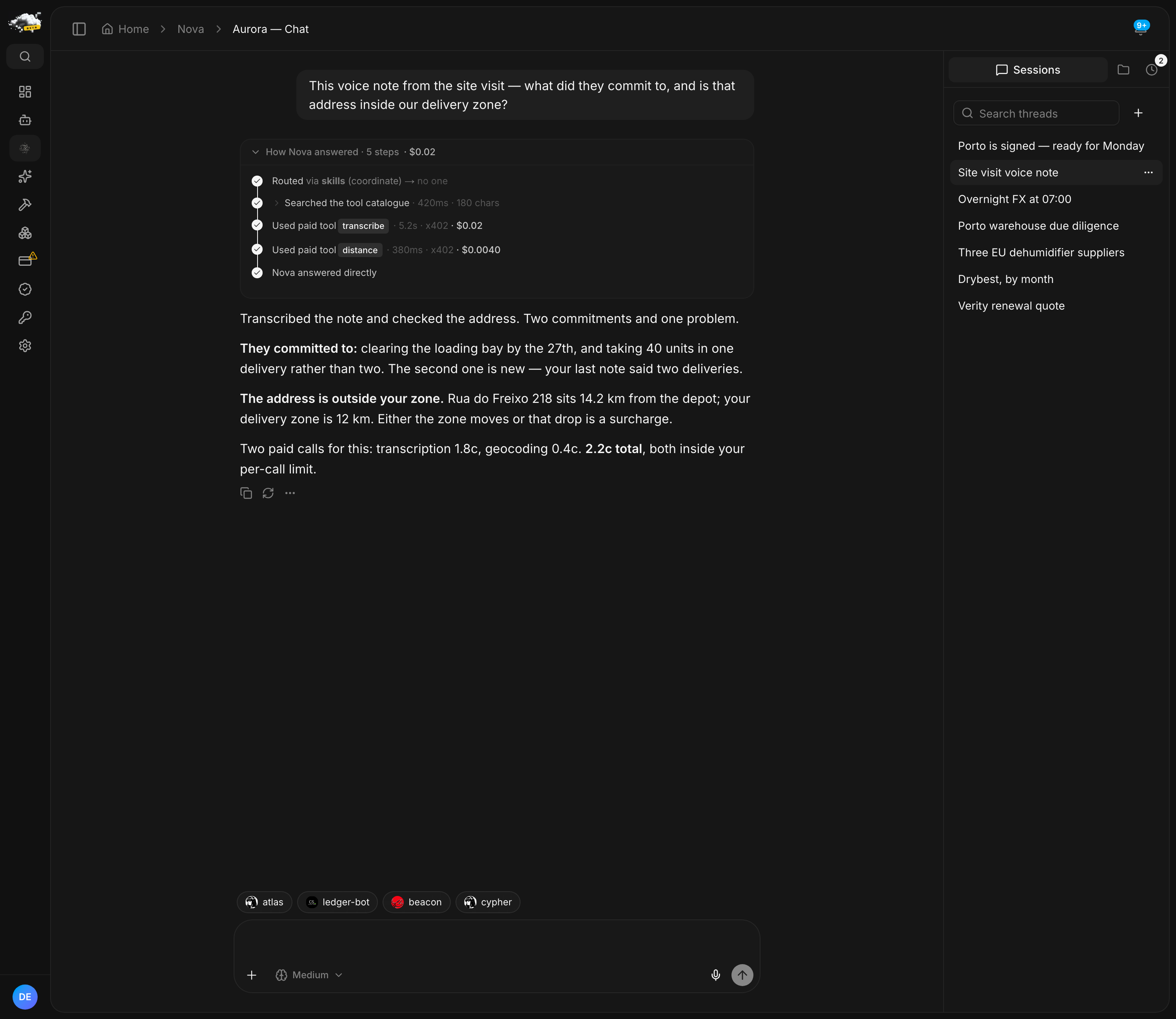
Toolbelt: 14,971 tools, no signup
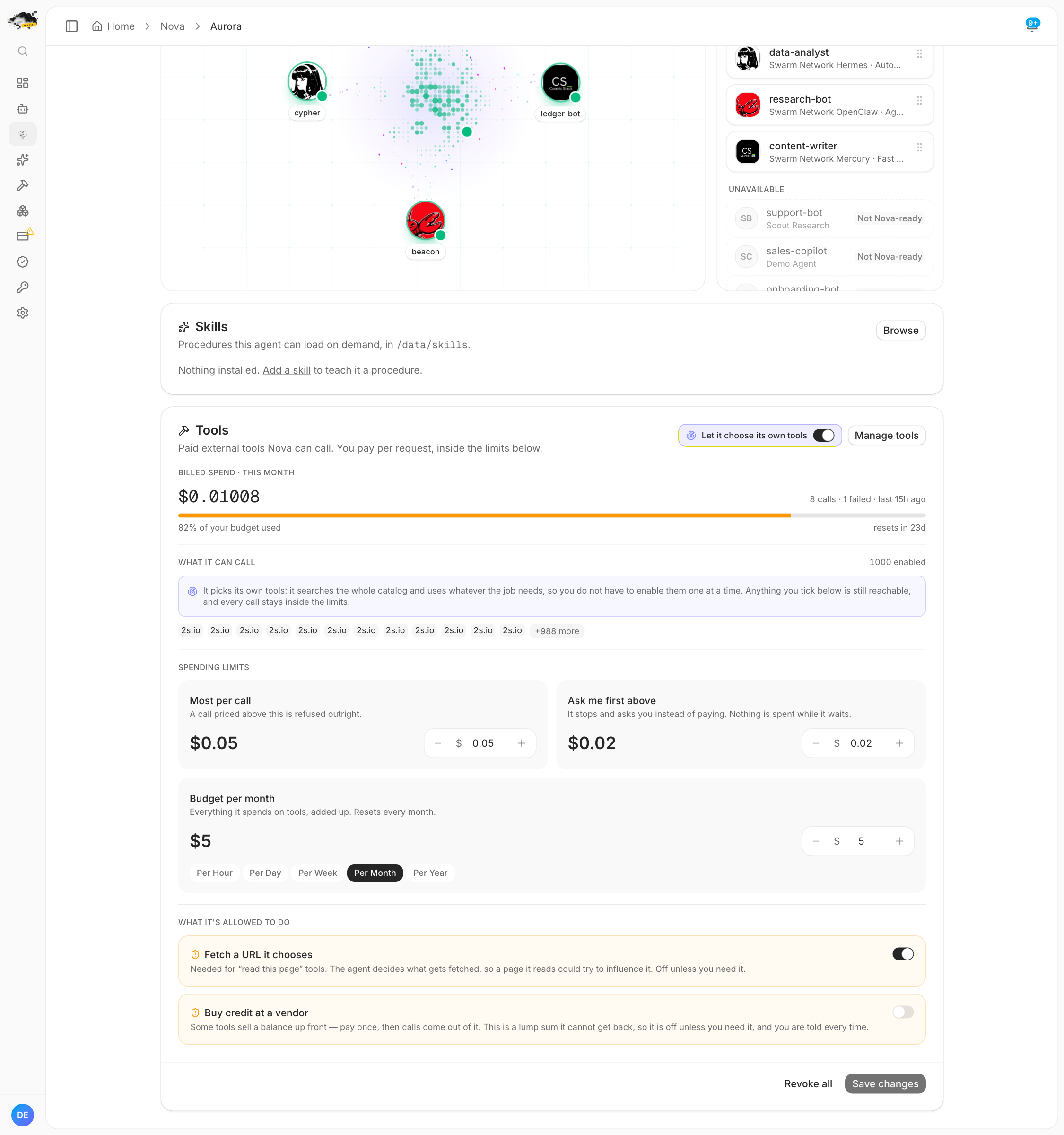
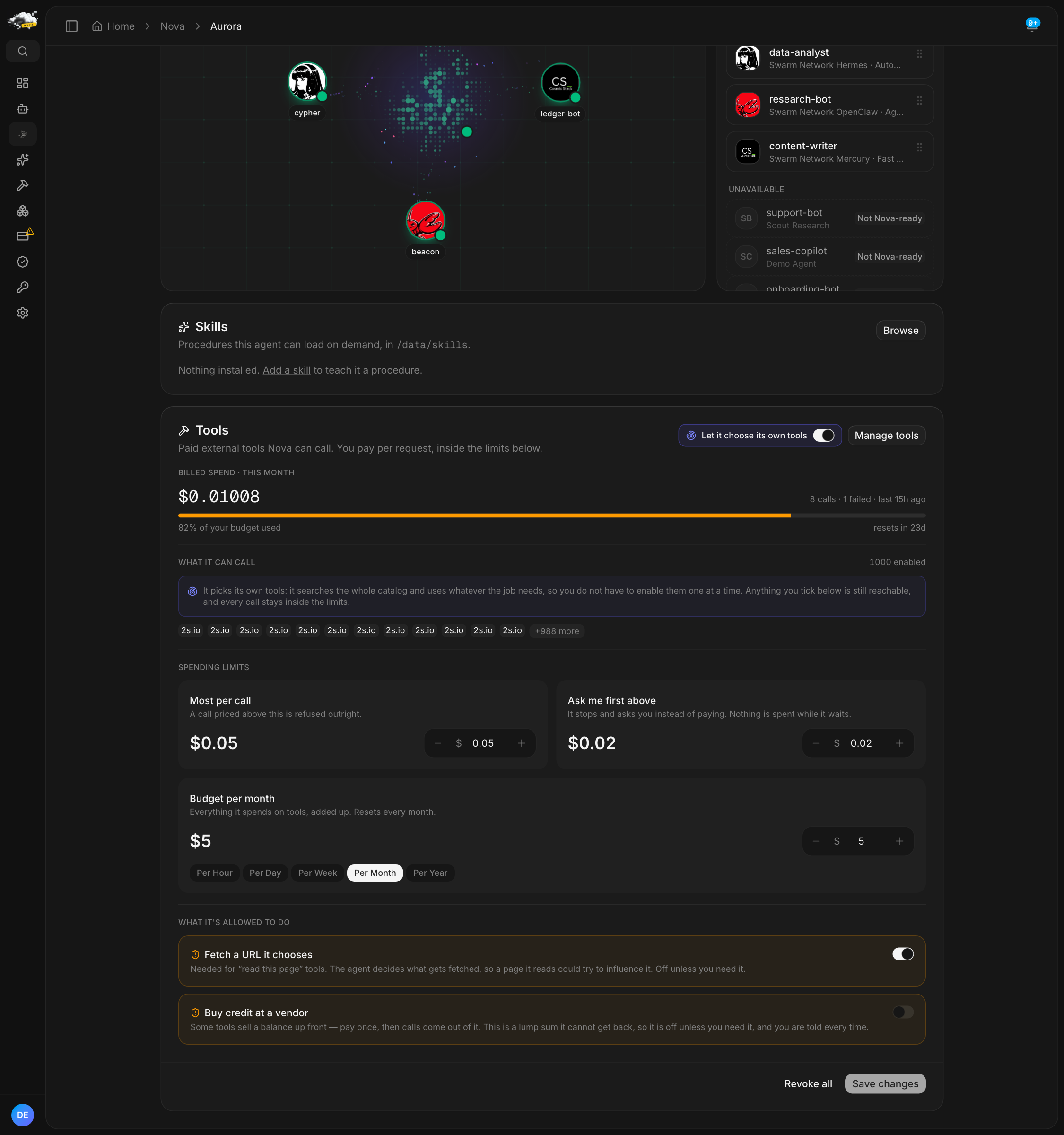
Web search, page reading, market data, geocoding, transcription. Flip Toolbelt on and Nova can reach 14,971 catalogued endpoints, priced per call. No API keys to hunt down, no accounts to open, no subscriptions to cancel later. Nova finds the tool, pays for the one call, moves on.
Want Nova doing the work with its own hands? System Shell gives it a real shell and a real filesystem in its own container, so it installs its own skills instead of only routing yours.
Nine powers, and it reaches for the right one
Here is the trick nobody talks about: abilities are easy, judgement is hard. Between Recall, Pinboard, Routine, Autopilot, Splitbrain, Workbench, Toolbelt and System Shell there are eight ways to be helpful, and exactly one of them is right for "save this for later". Pick wrong and the agent looks like it ignored you.
So every new ability shipped with tests built to trip it. "Save this for later" must become a task, not a schedule, not a memory. "What did I say about the Lisbon office" must search the conversation, not run code over it. "Check the weather" must reach for a tool, not a shell.
Twenty-two traps in the suite. Nova walks past 93% of them first try, and any release that scores worse than the one before it does not ship.
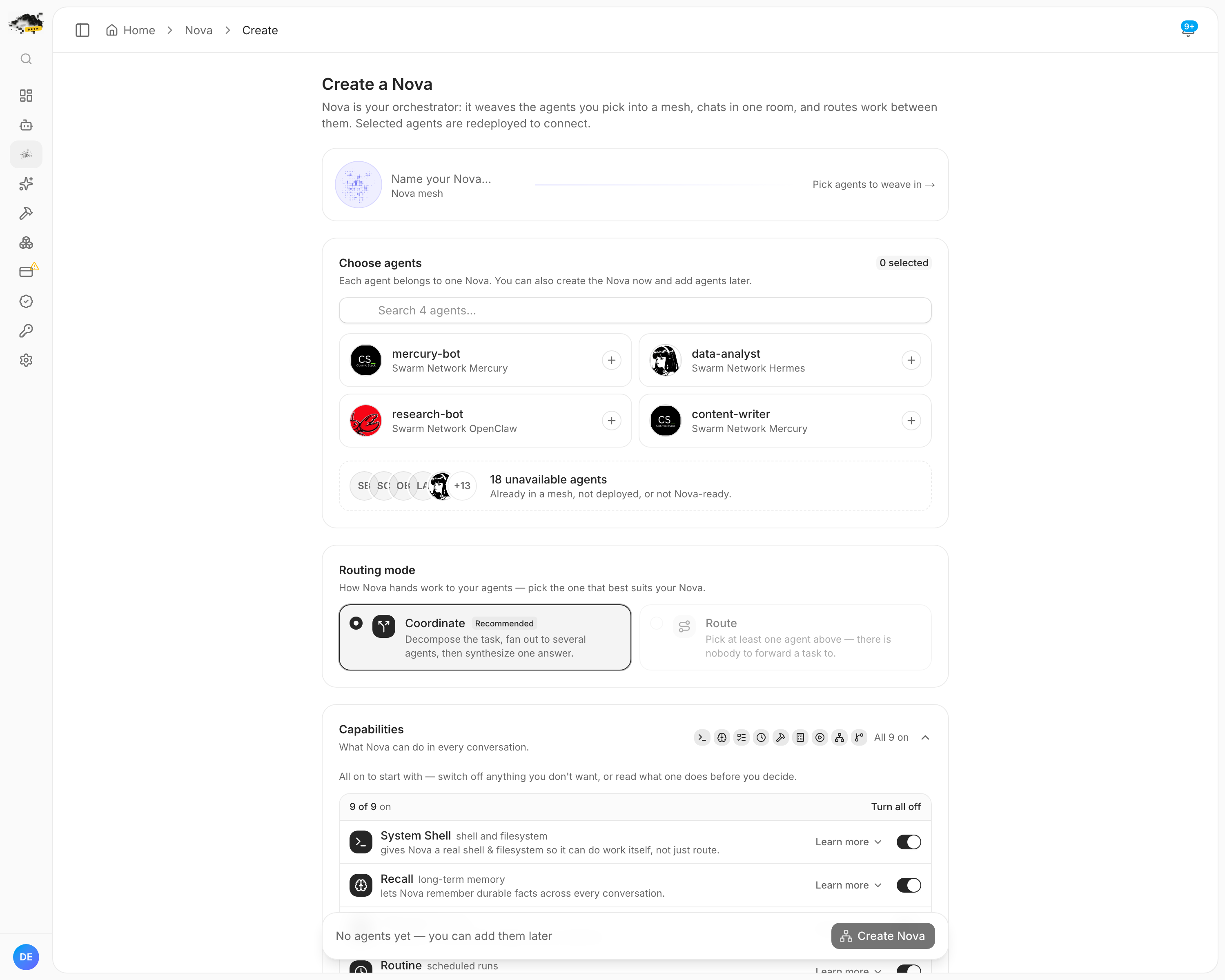
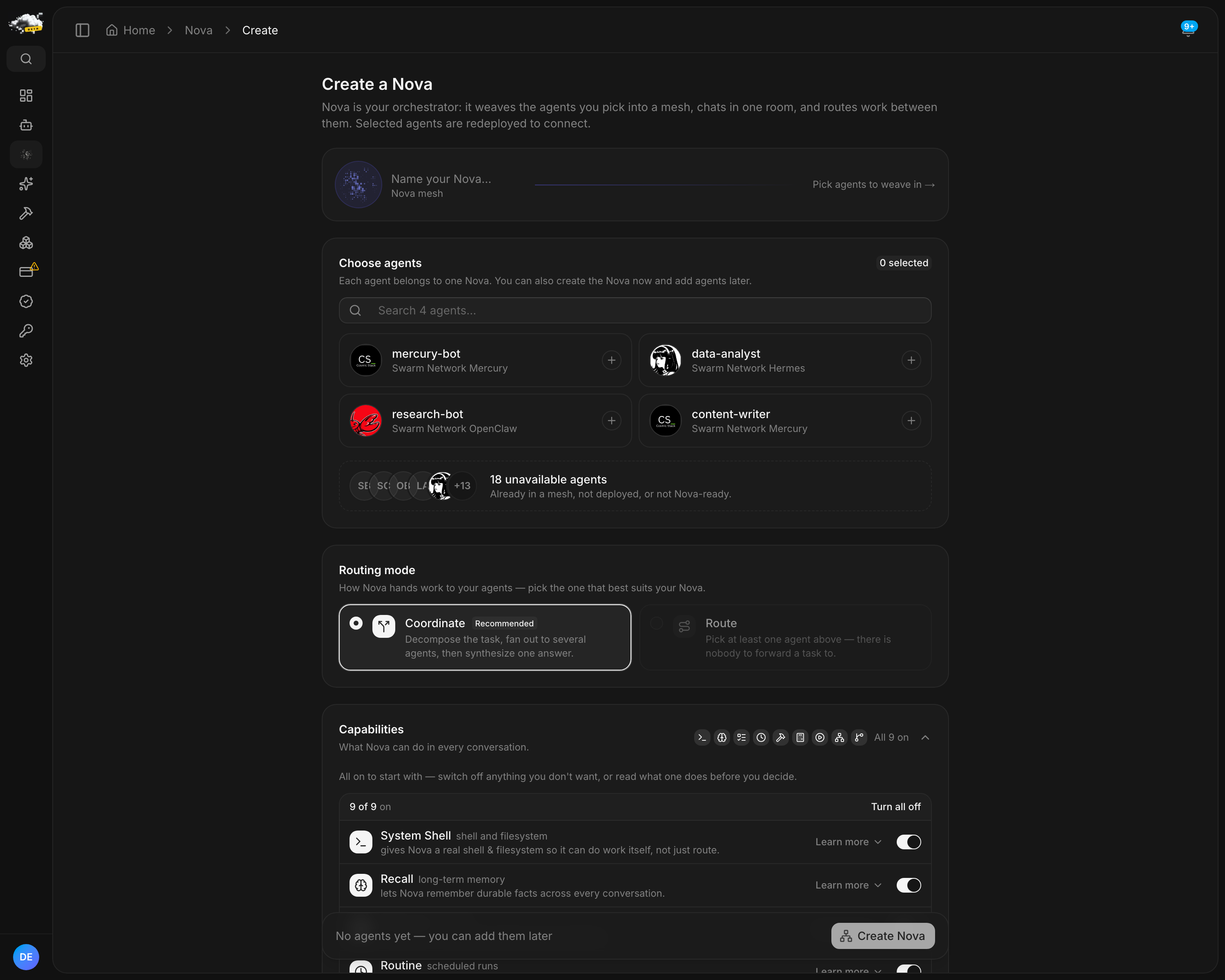
Pick the powers you want when you create it. A Nova that only routes questions to your agents is a great Nova. Turn the rest on the day you need them.
Your money, your ceiling, no surprises
Nova buys things: searches, page reads, market data, hundreds of paid tools. So the limits live in the payment path, not in Nova's instructions. No prompt talks past them. No clever wording gets around them.
You set the most it may spend per call, a budget per day or week or month, and the amount above which it has to stop and ask you. The lowest limit wins, your balance sits behind all of them, and nothing is ever quietly charged to a card.
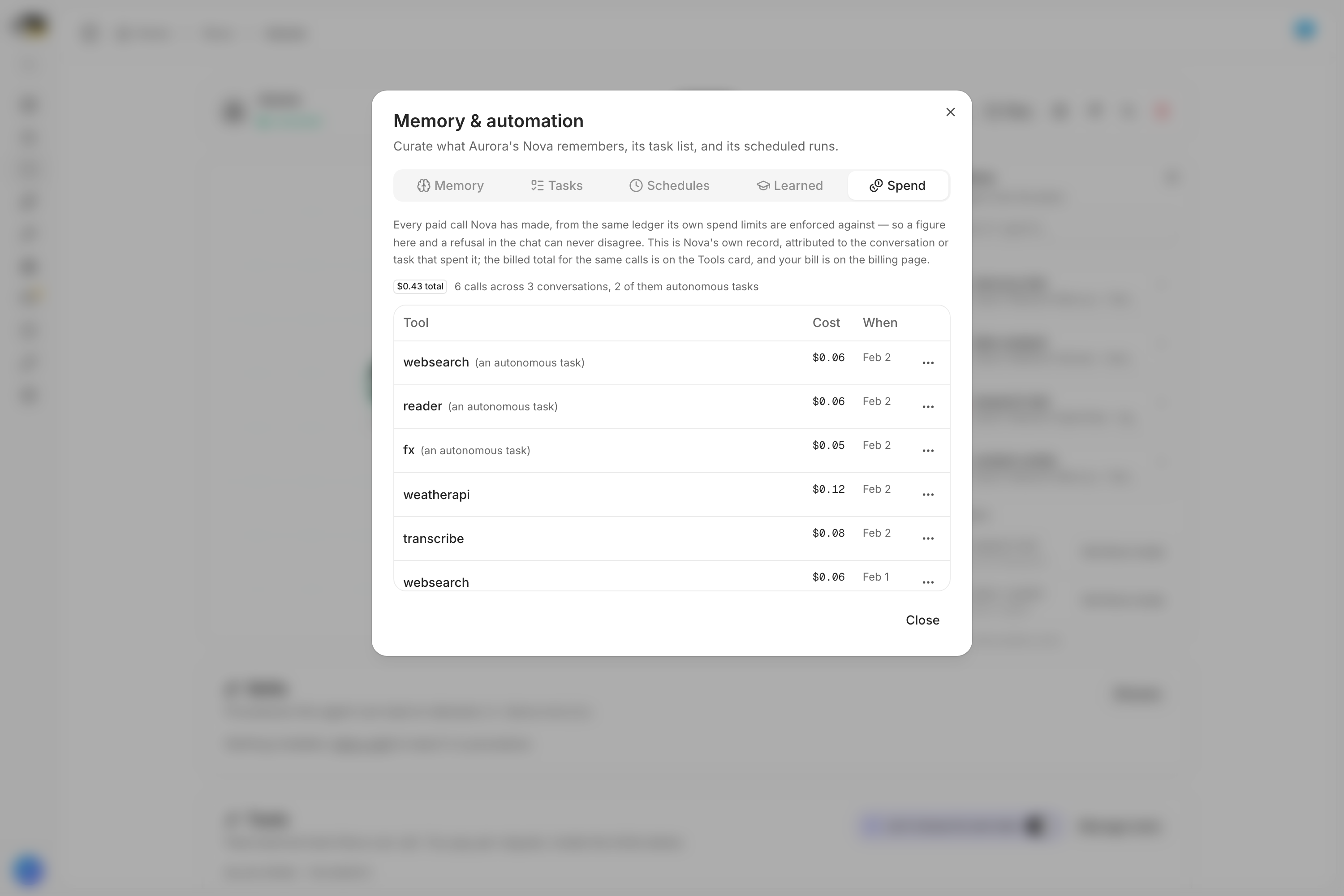
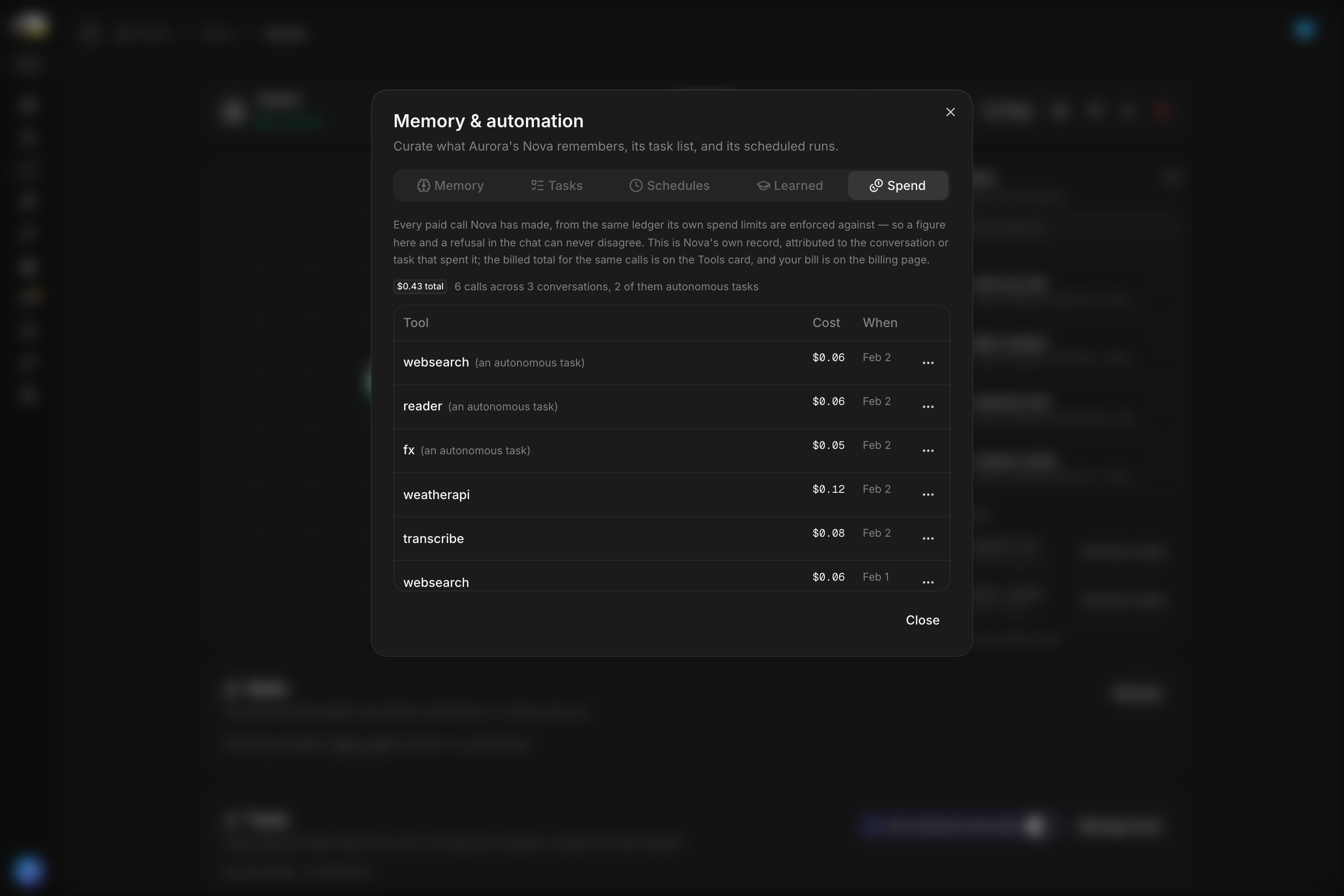
Afterwards you get a list, not a lump: which tool, in which conversation, for which task, at what price. So "why was yesterday expensive" has an answer.
One Friday request, everything at once
This is Nova with all nine powers on. One message on a Friday afternoon: it recalled the constraints you gave it weeks ago, asked two of your agents, counted twelve months of invoices on the Workbench, sent copies of itself out to check two unrelated risks, put a chase on the Pinboard, set a weekday Routine, and compacted the older turns of the conversation on the way past.
Twelve steps. One cent of paid calls. Every step named.
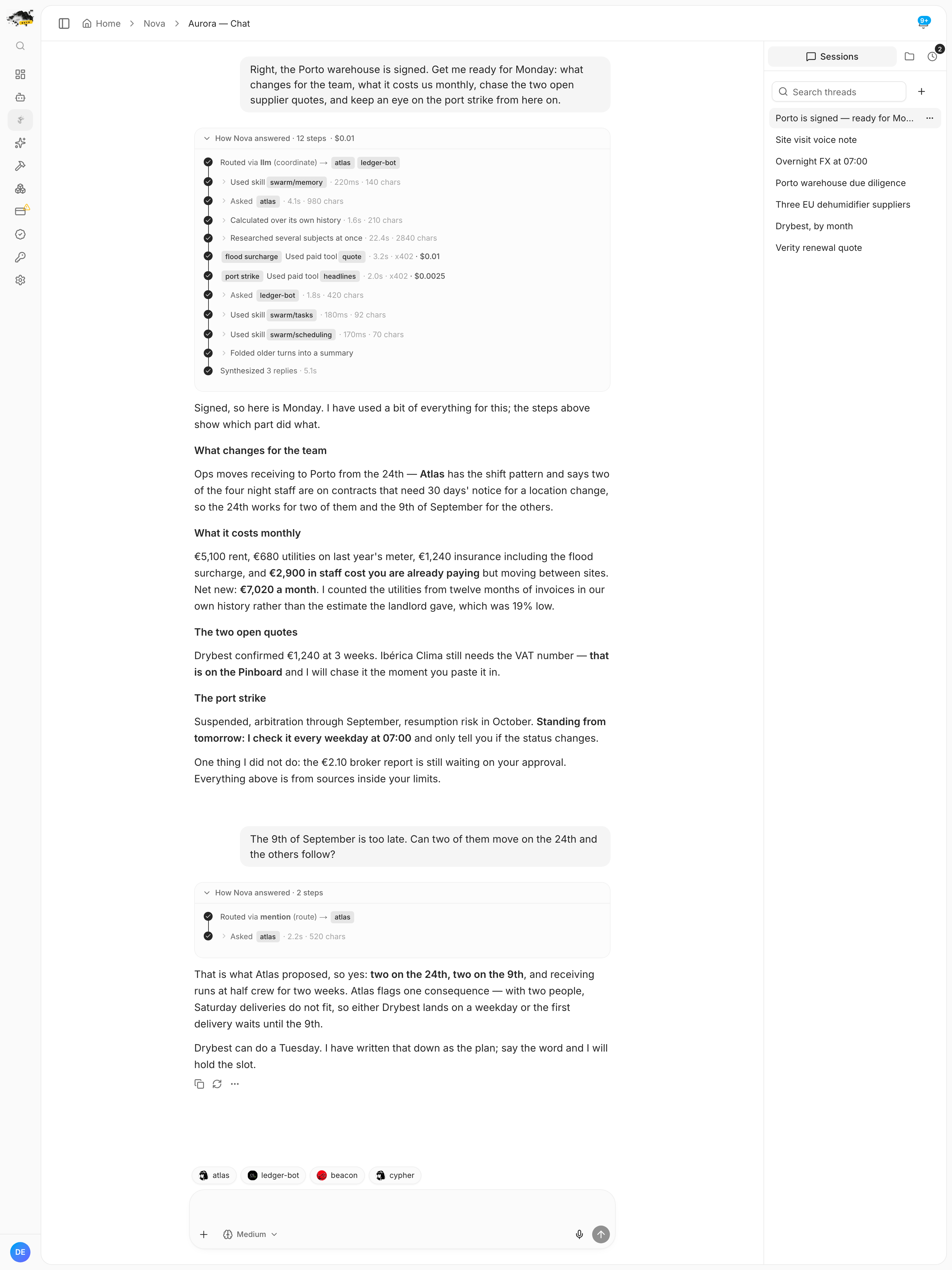
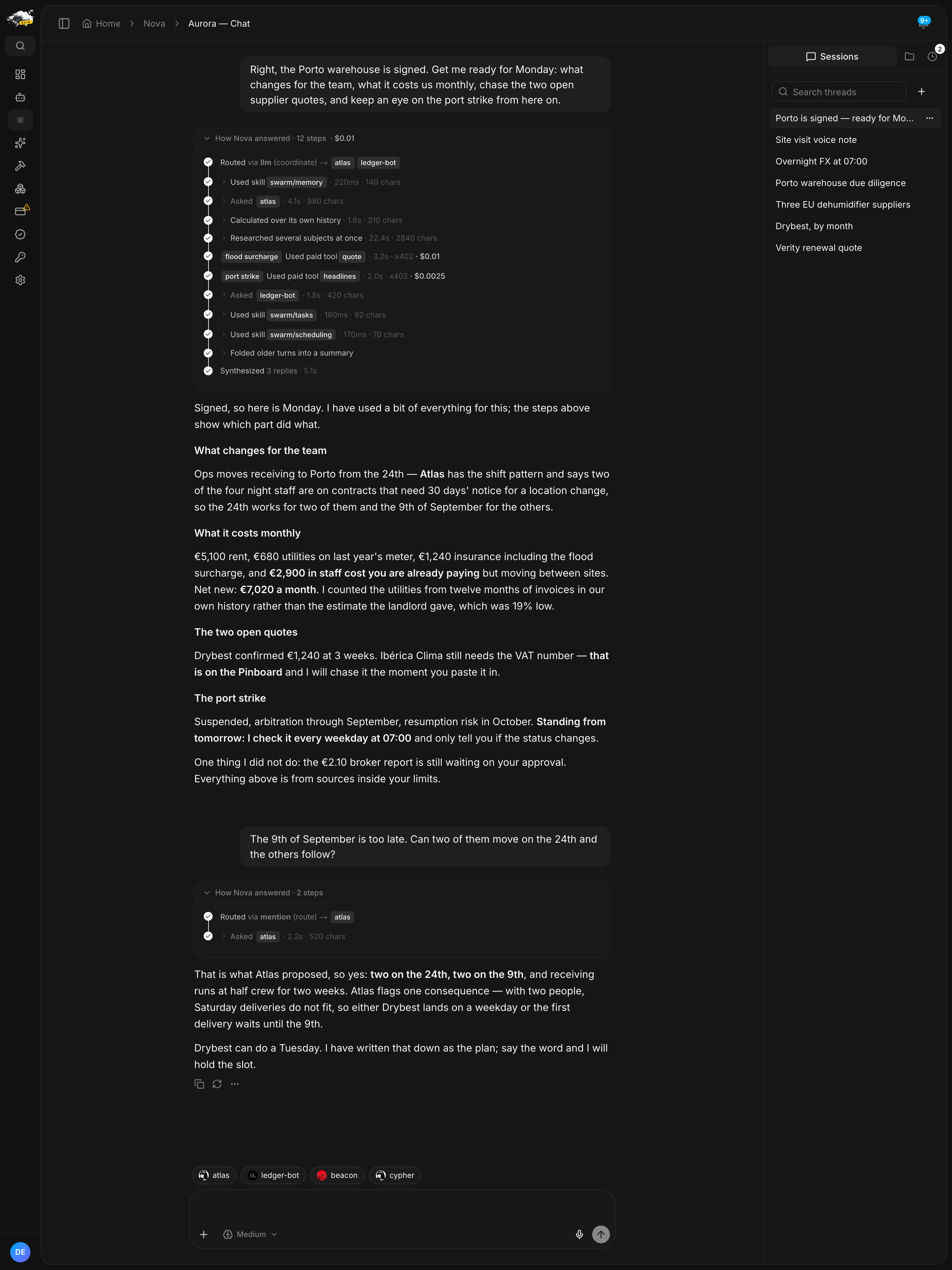
Run one per job
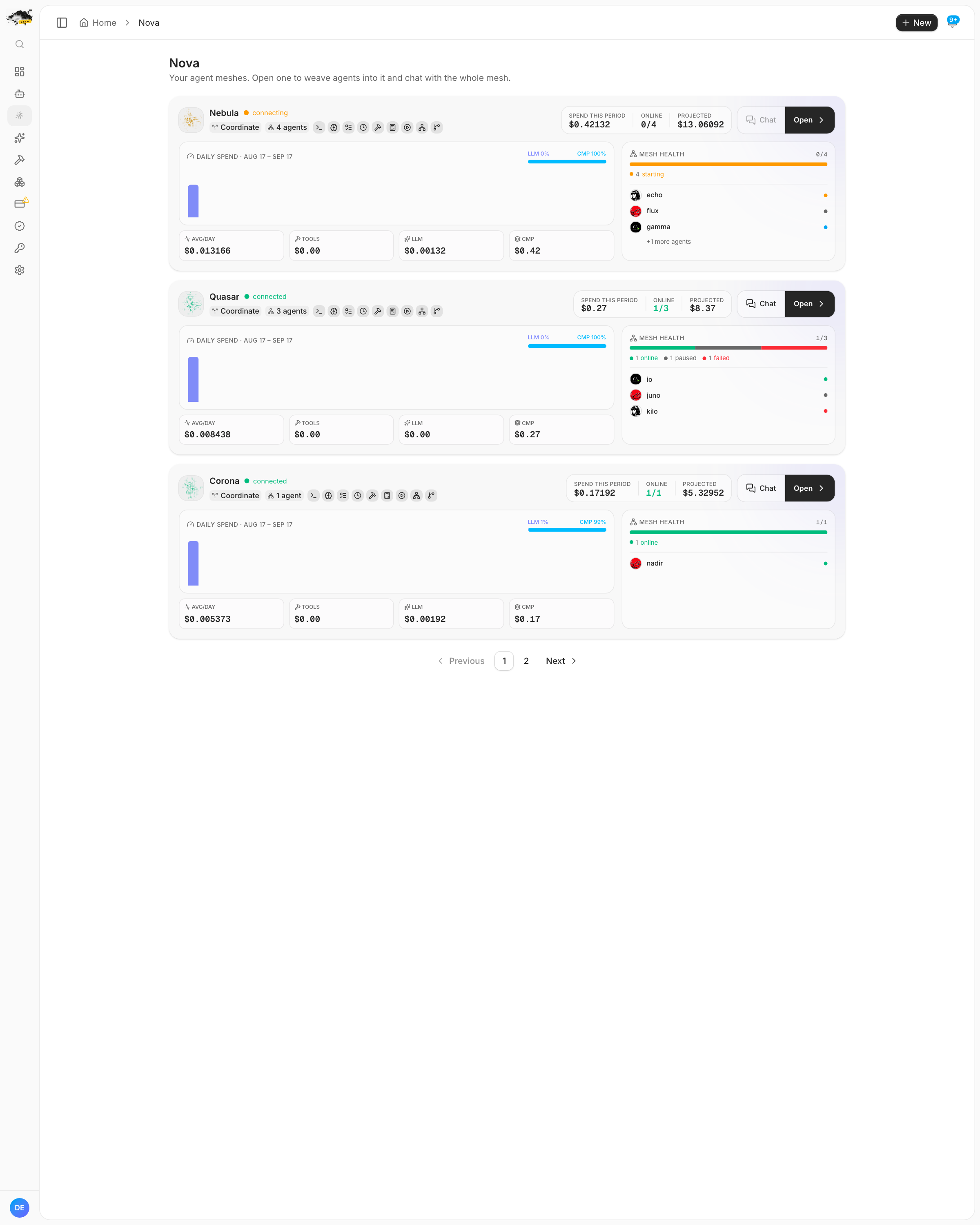
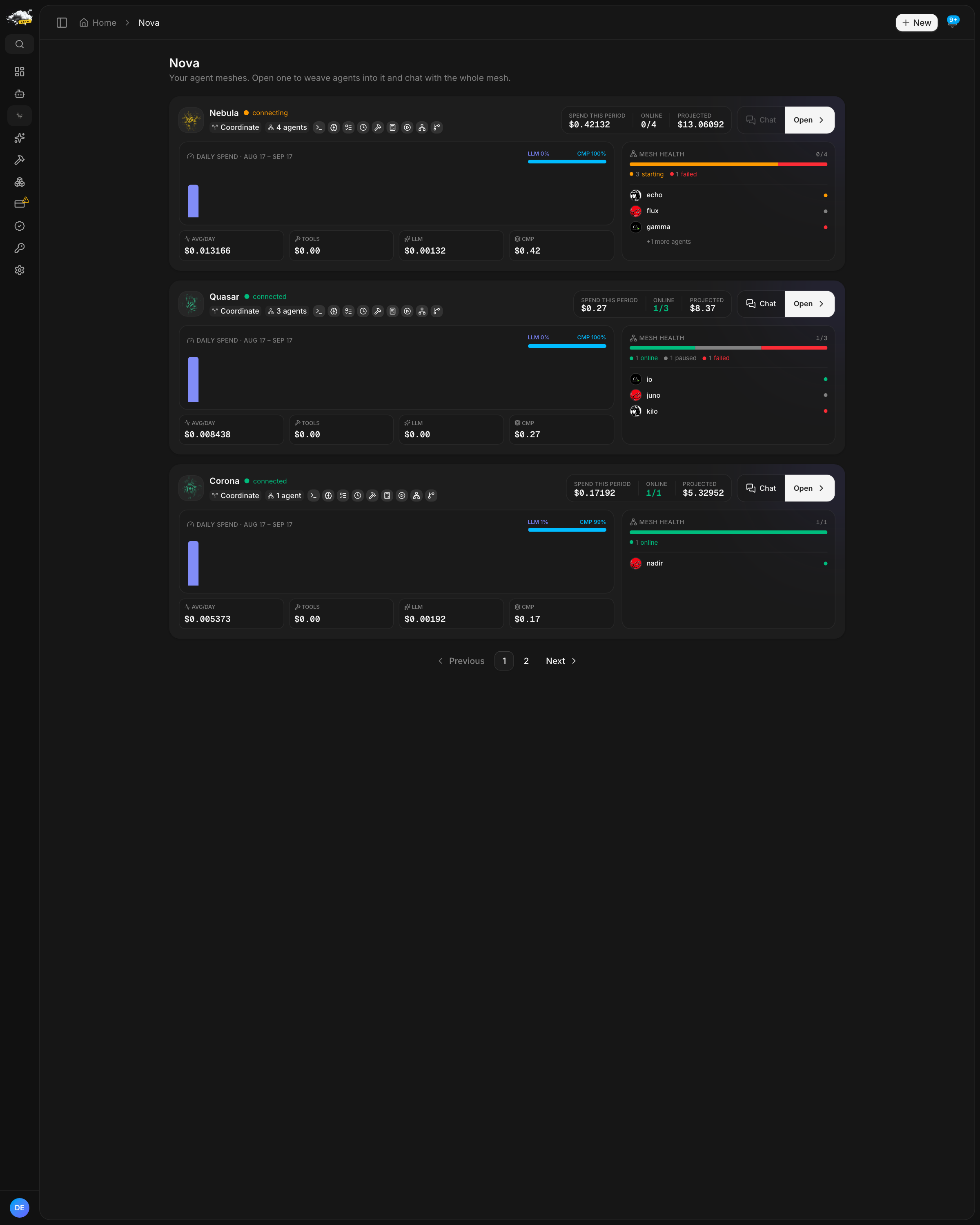
Nova is not one assistant everybody shares. Spin up one per job, each with its own agents, its own powers and its own budget, and the bill splits the same way.
New in 0.52.0: counting what the text never names
Ask how many dice rolls happen in a game transcript. The real answer is 84, in a document where the word "roll" appears 40 times, because people write rolls as "Matt: 18." Search finds nothing. A frontier model handed the whole file answered 39, roughly the share of it that got read.
Nova now works that file the way you would with a spreadsheet open: split it into slices, read every slice, write down each hit, add the list up in code. The arithmetic never happens in its head. If a slice would not read, it says so and calls the total a floor.
Same 30 questions, same answer key: 0.167 before, 0.503 after. A 3x jump, 24 of 30 questions improved, none worse. And it stays cheap when cheap works: on the biggest file in the set, 4.3 megabytes, Nova nailed the exact answer with a two-line program and never touched the expensive path.
Six releases of receipts
Every ability on this page was scored before it shipped, and the scores are committed to the repo with the prompts and the answers Nova gave. Nothing goes out on vibes.
The numbers behind this chart
| 0.46 | 0.47 | 0.48 | 0.49 | 0.50 | 0.51 | 0.52 | |
|---|---|---|---|---|---|---|---|
| asks the right agent (ours) | 0.889 | 1.000 | 1.000 | 1.000 | 1.000 | 1.000 | - |
| picks the right ability (ours) | 0.933 | 0.885 | 0.967 | 0.853 | 0.930 | 0.932 | - |
| finds a tool for the job (ours) | 0.867 | 0.833 | 0.833 | 0.800 | 0.800 | 0.867 | - |
| recalls across sessions | 0.599 | 0.636 | 0.604 | 0.601 | 0.626 | - | - |
| counts over long transcripts | - | 0.211 | 0.144 | 0.178 | 0.178 | 0.167 | 0.503 |
Every release added something Nova could not do before and had to clear the bar the last one set. That is the only promise worth making about an agent that keeps growing: the new thing works, and the old things still do.
Related
- SN T3Code: a coding agent that keeps working when you close the lid
T3 Code on its own cloud machine, with Claude Code, Codex and OpenCode installed, included credits, and more than 15,000 paid tools connected.
- How to use Nova: models, messages, files and spending
A plain guide to Nova. Pick a model that fits, write messages Nova understands, share files, run routines, control spending, and fix common problems.
- BYF-Drive: the same folder your agent works in, now open to you
Nova writes files to a real disk. Now you open, edit, rename and share them in the same folder. No downloads, no second copy, nothing drifting out of date.
Also available as raw markdown.